 Evidence Evidence
There is unequivocal evidence that Earth is warming at an
unprecedented rate. Human activity is the principal cause.
The rate of change since the mid-20th century is
unprecedented over millennia.
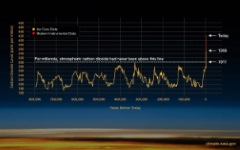
Earth's climate has changed throughout history. Just in the
last 800,000 years, there have been eight cycles of ice ages
and warmer periods, with the end of the last ice age about
11,700 years ago marking the beginning of the modern climate
era — and of human civilization. Most of these climate
changes are attributed to very small variations in Earth’s
orbit that change the amount of solar energy our planet
receives.
The current warming trend is different because it is clearly
the result of human activities since the mid-1800s, and is
proceeding at a rate not seen over many recent millennia. It
is undeniable that human activities have produced the
atmospheric gases that have trapped more of the Sun’s energy
in the Earth system. This extra energy has warmed the
atmosphere, ocean, and land, and widespread and rapid
changes in the atmosphere, ocean, cryosphere, and biosphere
have occurred. |
|
|
|
|
Do scientists agree on climate
change?
Earth-orbiting satellites and new technologies have helped
scientists see the big picture, collecting many different
types of information about our planet and its climate all
over the world. These data, collected over many years,
reveal the signs and patterns of a changing climate.
Scientists demonstrated the heat-trapping nature of carbon
dioxide and other gases in the mid-19th century. Many of the
science instruments NASA uses to study our climate focus on
how these gases affect the movement of infrared radiation
through the atmosphere. From the measured impacts of
increases in these gases, there is no question that
increased greenhouse gas levels warm Earth in response.
Ice cores drawn from Greenland, Antarctica, and tropical
mountain glaciers show that Earth’s climate responds to
changes in greenhouse gas levels. Ancient evidence can also
be found in tree rings, ocean sediments, coral reefs, and
layers of sedimentary rocks. This ancient, or paleoclimate,
evidence reveals that current warming is occurring roughly
10 times faster than the average rate of warming after an
ice age. Carbon dioxide from human activities is increasing
about 250 times faster than it did from natural sources
after the last Ice Age.
The Evidence for Rapid Climate
Change Is Compelling:
Global Temperature Is Rising
The planet's average surface temperature has risen about 2
degrees Fahrenheit (1 degrees Celsius) since the late 19th
century, a change driven largely by increased carbon dioxide
emissions into the atmosphere and other human activities.
Most of the warming occurred in the past 40 years, with the
seven most recent years being the warmest. The years 2016
and 2020 are tied for the warmest year on record.
The Ocean Is Getting Warmer
The ocean has absorbed much of this increased heat, with the
top 100 meters (about 328 feet) of ocean showing warming of
0.67 degrees Fahrenheit (0.33 degrees Celsius) since 1969.6
Earth stores 90% of the extra energy in the ocean.
The Ice Sheets Are Shrinking
The Greenland and Antarctic ice sheets have decreased in
mass. Data from NASA's Gravity Recovery and Climate
Experiment show Greenland lost an average of 279 billion
tons of ice per year between 1993 and 2019, while Antarctica
lost about 148 billion tons of ice per year.
Glaciers Are Retreating
Glaciers are retreating almost everywhere around the world —
including in the Alps, Himalayas, Andes, Rockies, Alaska,
and Africa.
Snow Cover Is Decreasing
Satellite observations reveal that the amount of spring snow
cover in the Northern Hemisphere has decreased over the past
five decades and the snow is melting earlier.
Sea Level Is Rising
Global sea level rose about 8 inches (20 centimeters) in the
last century. The rate in the last two decades, however, is
nearly double that of the last century and accelerating
slightly every year.
Arctic Sea Ice Is Declining
Both the extent and thickness of Arctic sea ice has declined
rapidly over the last several decades.
Extreme Events Are Increasing in
Frequency
The number of record high temperature events in the United
States has been increasing, while the number of record low
temperature events has been decreasing, since 1950. The U.S.
has also witnessed increasing numbers of intense rainfall
events.
Ocean Acidification Is Increasing
Since the beginning of the Industrial Revolution, the
acidity of surface ocean waters has increased by about 30%.
This increase is due to humans emitting more carbon dioxide
into the atmosphere and hence more being absorbed into the
ocean. The ocean has absorbed between 20% and 30% of total
anthropogenic carbon dioxide emissions in recent decades
(7.2 to 10.8 billion metric tons per year). |
|
|
|
|
Takeaways |
- While Earth’s climate has changed
throughout its history, the current warming is happening
at a rate not seen in the past 10,000 years.
- According to the Intergovernmental
Panel on Climate Change (IPCC), "Since systematic
scientific assessments began in the 1970s, the influence
of human activity on the warming of the climate system
has evolved from theory to established fact."
- Scientific information taken from
natural sources (such as ice cores, rocks, and tree
rings) and from modern equipment (like satellites and
instruments) all show the signs of a changing climate.
- From global temperature rise to
melting ice sheets, the evidence of a warming planet
abounds.
|
|
|
|
|