 Connection
Between the Jews and the Ten Lost Tribes of Israel and
Japanese Religion and Culture Connection
Between the Jews and the Ten Lost Tribes of Israel and
Japanese Religion and Culture
A bit of explanation is required before you begin reading.
I am Jewish and my wife is Japanese and our kids are being
raised with knowledge of holidays and customs connected to
both cultures. The possibility of a connection from long ago
is nothing less than fascinating.
The information on this page was obtained from
Remnant Publishing: Israelites Came To Ancient Japan.
The president of Remnant Publishing is Arimasa Kubo, a
Japanese writer living in Japan. Much of his published works
are very subjective to the point of being fringe theory.
According to
Wikipedia,
his theory has been debunked based on genetic testing
results which do not show any connection between Jews and
Japanese. Hey, back in the day reptiles where descendants of
dinosaurs and Pluto was still a planet....things change as
do theories. That said, the possibility of Jews and Japanese
being connected is an interesting read nonetheless. Enjoy.
Note: the following was
written by a native Japanese speaker with English as his
second language.
Additional Note:
the author
stated the following regarding the use of this material:
"Please feel free to print this site for your personal use,
and distribute it to your friends. If you are interested in
publishing this as a book to sell at bookstores in your
country, please let me know".
Israelites Came To Ancient Japan
Many of the traditional ceremonies in Japan seem to indicate
that the Lost Tribes of Israel came to ancient Japan.
The ancient kingdom of Israel, which consisted of 12 tribes,
was in 933 B.C.E. divided into the southern kingdom of Judah
and the northern kingdom of Israel. The 10 tribes out of 12
belonged to the northern kingdom and the rest to the
southern kingdom. The descendants from the southern kingdom
are called Jews. The people of the northern kingdom were
exiled to Assyria in 722 B.C.E. and did not come back to
Israel. They are called "the Ten Lost Tribes of Israel." The
following peoples are thought by Jewish scholars to be the
descendants from the Ten Lost Tribes of Israel. |
- Yusufzai - They live in Afghanistan.
Yusufzai means children of Joseph. They have customs of
ancient Israelites.
- Pathans - They live in Afghanistan
and Pakistan. They have the customs of circumcision on
the 8th day, fringes of robe, Sabbath, Kashrut, Tefilin,
etc.
- Kashmiri people - In Kashmir they
have the same land names as were in the ancient northern
kingdom of Israel. They have the feast of Passover and
the legend that they came from Israel.
- Knanites - In India there are people
called Knanites, which means people of Canaan. They
speak Aramaic and use the Aramaic Bible.
- Menashe tribe - In Myanmar (Burma)
and India live Menashe tribe. Menashe is Manasseh, and
the Menashe tribe is said to be the descendants from the
tribe of Manasseh, one of the Ten Lost Tribes of Israel.
They have ancient Israeli customs.
- Chiang-Min tribe - They live in
China and have ancient Israeli customs. They believe in
one God and have oral tradition that they came from far
west. They say that their ancestor had 12 sons. They
have customs of Passover, purification, levirate
marriage, etc. as ancient Israelites.
- Kaifeng, China - It is known that
there had been a large Jewish community since the time
of B.C.E..
- Japan - This I am going to discuss
about.
|
|
|
A Japanese Festival Illustrates the
Story of Isaac
In Nagano prefecture, Japan, there is a large Shinto shrine
named "Suwa-Taisha" (Shinto is the national traditional
religion peculiar to Japan.)
At Suwa-Taisha, the traditional festival called "Ontohsai"
is held on April 15 every year (When the Japanese used the
lunar calendar it was March-April). This festival
illustrates the story of Isaac in chapter 22 of Genesis in
the Bible - when Abraham was about to sacrifice his own son,
Isaac. The "Ontohsai" festival, held since ancient days, is
judged to be the most important festival of "Suwa-Taisha."
At the back of the shrine "Suwa-Taisha," there is a mountain
called Mt. Moriya ("Moriya-san" in Japanese). The people
from the Suwa area call the god of Mt. Moriya "Moriya no
kami," which means, the "god of Moriya." This shrine is
built to worship the "god of Moriya."
At the festival, a boy is tied up by a rope to a wooden
pillar, and placed on a bamboo carpet. A Shinto priest comes
to him preparing a knife, and he cuts a part of the top of
the wooden pillar, but then a messenger (another priest)
comes there, and the boy is released. This is reminiscent of
the Biblical story in which Isaac was released after an
angel came to Abraham.
At this festival, animal sacrifices are also offered. 75
deer are sacrificed, but among them it is believed that
there is a deer with its ear split. The deer is considered
to be the one God prepared. It could have had some
connection with the ram that God prepared and was sacrificed
after Isaac was released. Since the ram was caught in the
thicket by the horns, the ear might have been split.
In ancient time of Japan there were no sheep and it might be
the reason why they used deer (deer is Kosher). Even in
historic times, people thought that this custom of deer
sacrifice was strange, because animal sacrifice is not a
Shinto tradition.
My friend went to Israel and saw a Passover festival on Mt.
Gerizim in Samaria. He asked a Samaritan priest how many
rams were offered. The priest answered that they used to
offer 75. This may have a connection with the 75 deer which
were offered at Suwa-Taisha shrine in Japan.
People call this festival "the festival for Misakuchi-god".
"Misakuchi" might be "mi-isaku-chi." "Mi" means "great," "isaku"
is most likely Isaac (the Hebrew word "Yitzhak"), and "chi"
is something for the end of the word. It seems that the
people of Suwa made Isaac a god, probably by the influence
of idol worshipers.
Today, this custom of the boy about to be sacrificed and
then released, is no longer practiced, but we can still see
the custom of the wooden pillar called "oniye-basira," which
means, "sacrifice-pillar."
Currently, people use stuffed animals instead of performing
a real animal sacrifice. Tying a boy along with animal
sacrifice was regarded as savage by people of the Meiji-era
(about 100 years ago), and those customs were discontinued.
However, the festival itself still remains.
The custom of the boy had been maintained until the
beginning of Meiji era. Masumi Sugae, who was a Japanese
scholar and a travel writer in the Edo era (about 200 years
ago), wrote a record of his travels and noted what he saw at
Suwa. The record shows the details of "Ontohsai." It tells
that the custom of the boy about to be sacrificed and his
ultimate release, as well as animal sacrifices that existed
those days. His records are kept at the museum near
Suwa-Taisha.
The festival of "Ontohsai" has been maintained by the Moriya
family ever since ancient times. The Moriya family think of
"Moriya-no-kami" (god of Moriya) as their ancestor's god.
They also consider "Mt. Moriya" as their holy place. The
name, "Moriya," could have come from "Moriah" (the Hebrew
word "Moriyyah") of Genesis 22:2, that is today's Temple
Mount of Jerusalem. Among Jews, God of Moriah means the one
true God whom the Bible teaches.
The Moriya family have been hosting the festival for 78
generations. And the curator of the museum said to me that
the faith in the god of Moriya had existed among the people
since the time of B.C.E..
Apparently, no other country but Japan has a festival
illustrating the biblical story of Abraham and Isaac. This
tradition appears to provide strong evidence that the
ancient Israelites came to ancient Japan. |
|
|
 The Crest of the Imperial House of
Japan Is the Same As That Found On the Gate of Jerusalem The Crest of the Imperial House of
Japan Is the Same As That Found On the Gate of Jerusalem
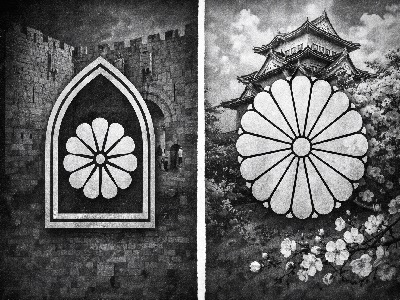
The crest of the Imperial House of Japan is a round mark in
the shape of a flower with 16 petals. The current shape
appears as a chrysanthemum (mum), but scholars say that in
ancient times, it appeared similar to a sunflower. The
sunflower appearance is the same as the mark at Herod's gate
in Jerusalem. The crest at Herod's gate also has 16 petals.
This crest of the Imperial House of Japan has existed since
very ancient times. The same mark as the one at Herod's gate
is found on the relics of Jerusalem from the times of the
Second Temple, and also on Assyrian relics from the times of
B.C.E.. |
|
|
 Japanese Religious Priests "Yamabushi"
Put A Black Box on their Foreheads Just As Jews Put A
Phylactery on their Foreheads. Japanese Religious Priests "Yamabushi"
Put A Black Box on their Foreheads Just As Jews Put A
Phylactery on their Foreheads.
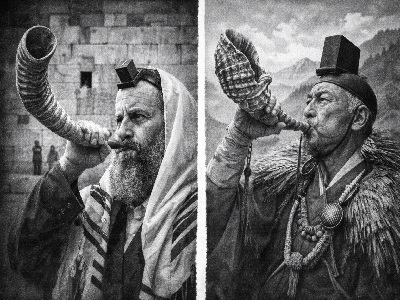
"Yamabushi" is a religious man in training unique to Japan.
Today, they are thought to belong to Japanese Buddhism.
However, Buddhism in China, Korea and India have no such
custom. The custom of "yamabushi" existed in Japan before
Buddhism was imported into Japan in the seventh century.
On the forehead of "Yamabushi," he puts a black small box
called a "tokin", which is tied to his head with a black
cord. He greatly resembles a Jew putting on a phylactery
(black box) on his forehead with a black cord. The size of
this black box "tokin" is almost the same as the Jewish
phylactery, but its shape is round and flower-like.
Originally the Jewish phylactery placed on the forehead
seems to have come from the forehead "plate" put on the high
priest Aaron with a cord (Exodus 28:36-38). It was about 4
centimeters (1.6 inches) in size according to folklore, and
some scholars maintain that it was flower-shaped. If so, it
was very similar to the shape of the Japanese "tokin" worn
by the "yamabushi".
Israel and Japan are the only two countries that in the
world I know of that use of the black forehead box for
religious purpose. Furthermore, the "yamabushi" use a big
seashell as a horn. This is very similar to Jews blowing a
shofar or ram's horn. The way it is blown and the sounds of
the "yamabushi's" horn are very similar to those of a shofar.
Because there are no sheep in Japan, the "yamabushi" had to
use seashell horns instead of rams' horns. "Yamabushis" are
people who regard mountains as their holy places for
religious training. The Israelites also regarded mountains
as their holy places. The Ten Commandments of the Torah were
given on Mt. Sinai. Jerusalem is a city on a mountain. Jesus
(Yeshua) used to climb up the mountain to pray. His apparent
transfiguration also occurred on a mountain.
In Japan, there is the legend of "Tengu" who lives on a
mountain and has the figure of a "yamabushi". He has a
pronounced nose and supernatural capabilities. A "ninja",
who was an agent or spy in the old days, while working for
his lord, goes to "Tengu" at the mountain to get from him
supernatural abilities. "Tengu" gives him a "tora-no-maki"
(a scroll of the "tora") after giving him additional powers.
This "scroll of the tora" is regarded as a very important
book which is helpful for any crisis. Japanese use this word
sometimes in their current lives.
There is no knowledge that a real scroll of a Jewish Torah
was ever found in a Japanese historical site. However, it
appears this "scroll of the tora" is a derivation of the
Jewish Torah. |
|
|
 Japanese "Omikoshi" Resembles the
Ark of the Covenant Japanese "Omikoshi" Resembles the
Ark of the Covenant
In the Bible, in First Chronicles, chapter 15, it is written
that David brought up the ark of the covenant of the Lord
into Jerusalem.
"David and the elders of Israel and the commanders of units
of a thousand went to bring up the ark of the covenant of
the LORD from the house of Obed-Edom, with rejoicing. ...Now
David was clothed in a robe of fine linen, as were all the
Levites who were carrying the ark, and as were the singers,
and Kenaniah, who was in charge of the singing of the
choirs. David also wore a linen ephod. So all Israel brought
up the ark of the covenant of the LORD with shouts, with the
sounding of rams' horns and trumpets, and of cymbals, and
the playing of lyres and harps." (15:25-28)
When I read these passages, I think; "How well does this
look like the scene of Japanese people carrying our 'omikoshi'
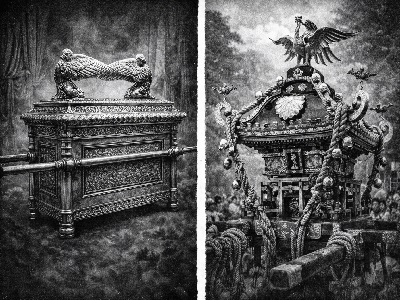
during festivals? The shape of the Japanese 'Omikoshi'
appears similar to the ark of the covenant. Japanese sing
and dance in front of it with shouts, and to the sounds of
musical instruments. These are quite similar to the customs
of ancient Israel."
Japanese carry the "omikoshi" on their shoulders with poles
- usually two poles. So did the ancient Israelites:
"The Levites carried the ark of God with poles on their
shoulders, as Moses had commanded in accordance with the
word of the LORD." (1 Chronicles 15:15)
The Israeli ark of the covenant had two poles (Exodus
25:10-15).
Some restored models of the ark as it was imagined to be
have used two poles on the upper parts of the ark. But the
Bible says those poles were to be fastened to the ark by the
four rings "on its four feet" (Exodus 25:12). Hence, the
poles must have been attached on the bottom of the ark. This
is similar to the Japanese "omikoshi."
The Israeli ark had two statues of gold cherubim on its top.
Cherubim are a type of angel, heavenly being having wings
like birds. Japanese "omikoshi" also have on its top the
gold bird called "Ho-oh" which is an imaginary bird and a
mysterious heavenly being.
The entire Israeli ark was overlaid with gold. Japanese "omikoshi"
are also overlaid partly and sometimes entirely with gold.
The size of an "omikoshi" is almost the same as the Israeli
ark. Japanese "omikoshi" could be a remnant of the ark of
ancient Israel.
Many Things Concerning the Ark
Resemble Japanese Customs
King David and people of Israel sang and danced to the
sounds of musical instruments in front of the ark. We
Japanese sing and dance to the sounds of musical instruments
in front of "omikoshi" as well.
Several years ago, I saw an American-made movie titled "King
David" which was a faithful story of the life of King David.
In the movie, David was seen dancing in front of the ark
while it was being carried into Jerusalem. I thought: "If
the scenery of Jerusalem were replaced by Japanese scenery,
this scene would be just the same as what can be observed in
Japanese festivals." The atmosphere of the music also
resembles the Japanese style. David's dancing appears
similar to Japanese traditional dancing.
At the Shinto shrine festival of "Gion-jinja" in Kyoto, men
carry "omikoshi," then enter a river, and cross it. I can't
help but think this originates from the memory of the
Ancient Israelites carrying the ark as they crossed the
Jordan river after their exodus from Egypt.
In a Japanese island of the Inland Sea of Seto, the men
selected as the carriers of the "omikoshi" stay together at
a house for one week before they would carry the "omikoshi."
This is to prevent profaning themselves. Furthermore on the
day before they carry "omikoshi," the men bathe in seawater
to sanctify themselves. This is similar to an ancient
Israelite custom:
"So the priests and the Levites sanctified themselves to
bring up the ark of the Lord God of Israel." (1 Chronicles
15:14)
The Bible says that after the ark entered Jerusalem and the
march was finished, "David distributed to everyone of
Israel, both man and woman, to everyone a loaf of bread, a
piece of meat, and a cake of raisins" (1 Chronicles 16:3).
This is similar to a Japanese custom. Sweets are distributed
to everyone after a Japanese festival. It was a delight
during my childhood.
The Robe of Japanese Priests
Resembles the Robe of Israeli Priests
The Bible says that when David brought up the ark into
Jerusalem, "David was clothed in a robe of fine linen" (1
Chronicles 15:27). The same was true for the priests and
choirs. In the Japanese Bible, this verse is translated into
"robe of white linen."
In ancient Israel, although the high priest wore a colorful
robe, ordinary priests wore simple white linen. Priests wore
white clothes at holy events. Japanese priests also wear
white robes at holy events.
In Ise-jingu, one of the oldest Japanese shrines, all of the
priests wear white robes. And in many Japanese Shinto
shrines, especially traditional ones, the people wear white
robes when they carry the "omikoshi" just like the
Israelites did.
Buddhist priests wear luxurious colorful robes. However, in
the Japanese Shinto religion, white is regarded as the
holiest color.
The Emperor of Japan, just after he finishes the ceremony of
his accession to the throne, appears alone in front of the
Shinto god. When he arrives there, he wears a pure white
robe covering his entire body except that his feet are
naked. This is similar to the action of Moses and Joshua who
removed their sandals in front of God to be in bare feet
(Exodus 3:5, Joshua 5:15).
Marvin Tokayer, a rabbi who lived in Japan for 10 years,
wrote in his book:
"The linen robes which Japanese Shinto priests wear have the
same figure as the white linen robes of the ancient priests
of Israel. "
The Japanese Shinto priest robe has cords of 20-30
centimeters long (about 10 inches) hung from the corners of
the robe. These fringes are similar to those of the ancient
Israelites. Deuteronomy 22:12 says:
"make them fringes in the... corners of their garments
throughout their generations."
Fringes (tassels) were a token that a person was an
Israelite. In the gospels of the New Testament, it is also
written that the Pharisees "make their tassels on their
garments long" (Matthew 23:5). A woman who had been
suffering from a hemorrhage came to Jesus (Yeshua) and
touched the "tassel on His coat" (Matthew 9:20, The New
Testament: A Translation in the Language of the People,
translated by Charles B. Williams).
Imagined pictures of ancient Israeli clothing sometimes do
not have fringes. But their robes actually had fringes. The
Jewish Tallit (prayer shawl), which the Jews put on when
they pray, has fringes in the corners according to
tradition.
Japanese Shinto priests wear on their robe a rectangle of
cloth from their shoulders to thighs. This is the same as
the ephod worn by David:
"David also wore a linen ephod." (1 Chronicles 15:27)
Although the ephod of the high priest was colorful with
jewels, the ordinary priests under him wore the ephods of
simple white linen cloth (1 Samuel 22:18). Rabbi Tokayer
states that the rectangle of cloth on the robe of Japanese
Shinto priest looks very similar to the ephod of the Kohen,
the Jewish priest.
The Japanese Shinto priest puts a cap on his head just like
Israeli priest did (Exodus 29:40). The Japanese priest also
puts a sash on his waist. So did the Israeli priest. The
clothing of Japanese Shinto priests appears to be similar to
the clothing used by ancient Israelites.
Waving the Sheaf of Harvest Is Also
the Custom of Japan
The Jews wave a sheaf of their first fruits of grain seven
weeks before Shavuot (Pentecost, Leviticus 23:10-11), They
also wave a sheaf of plants at Sukkot (the Feast of Booths,
Leviticus 23:40). This has been a tradition since the time
of Moses. Ancient Israeli priests also waved a plant branch
when he sanctifies someone. David said, "Purge me with
hyssop, and I shall be clean" [Psalm 51:7(9)]. This is also
a traditional Japanese custom.
When a Japanese priest sanctifies someone or something, he
waves a tree branch. Or he waves a "harainusa," which is
made of a stick and white papers and looks like a plant.
Today's "harainusa" is simplified and made of white papers
that are folded in a zig-zag pattern like small lightning
bolts, but in old days it was a plant branch or cereals.
A Japanese Christian woman acquaintance of mine used to
think of this "harainusa" as merely a pagan custom. But she
later went to the U.S.A. and had an opportunity to attend a
Sukkot ceremony. When she saw the Jewish waving of the sheaf
of the harvest, she shouted in her heart, "Oh, this is the
same as a Japanese priest does! Here lies the home for the
Japanese."
The Structure of the Japanese Shinto
Shrine is Similar to God's Tabernacle of Ancient Israel
The inside of God's tabernacle in ancient Israel was divided
into two parts. The first was the Holy Place, and the second
was the Holy of Holies. The Japanese Shinto shrine is also
divided into two parts.
The functions performed in the Japanese shrine are similar
to those of the Israeli tabernacle. Japanese pray in front
of its Holy Place. They cannot enter inside. Only Shinto
priests and special ones can enter. Shinto priest enters the
Holy of Holies of the Japanese shrine only at special times.
This is similar to the Israeli tabernacle.
The Japanese Holy of Holies is located usually in far west
or far north of the shrine. The Israeli Holy of Holies was
located in far west of the temple. Shinto's Holy of Holies
is also located on a higher level than the Holy Place, and
between them are steps. Scholars state that, in the Israeli
temple built by Solomon, the Holy of Holies was on an
elevated level as well, and between them there were steps of
about 2.7 meters (9 feet) in width.
In front of a Japanese shrine, there are two statues of
lions known as "komainu" that sit on both sides of the
approach. They are not idols but guards for the shrine. This
was also a custom of ancient Israel. In God's temple in
Israel and in the palace of Solomon, there were statues or
relieves of lions (1 Kings 7:36, 10:19).
In the early history of Japan, there were absolutely no
lions. But the statues of lions have been placed in Japanese
shrines since ancient times. It has been proven by scholars
that statues of lions located in front of Japanese shrines
originated from the Middle East.
Located near the entrance of a Japanese shrine is a "temizuya"
- a place for worshipers to wash their hands and mouth. They
used to wash their feet, too, in old days. This is a similar
custom as is found in Jewish synagogues. The ancient
tabernacle and temple of Israel also had a laver for washing
hands and feet near the entrances.
In front of a Japanese shrine, there is a gate called the "torii."
The type gate does not exist in China or in Korea, it is
peculiar to Japan. The "torii" gate consists of two vertical
pillars and a bar connecting the upper parts. But the oldest
form consists of only two vertical pillars and a rope
connecting the upper parts. When a Shinto priest bows to the
gate, he bows to the two pillars separately. It is assumed
that the "torii" gate was originally constructed of only two
pillars.
In the Israeli temple, there were two pillars used as a gate
(1 Kings 7:21). And in Aramaic language which ancient
Israelites used, the word for gate was "taraa." This word
might have changed slightly and become the Japanese "torii".
Some "toriis," especially of old shrines, are painted red. I
can't help but think this is a picture of the two door posts
and the lintel on which the blood of the lamb was put the
night before the exodus from Egypt.
In the Japanese Shinto religion, there is a custom to
surround a holy place with a rope called the "shimenawa,"
which has slips of white papers inserted along the bottom
edge of the rope. The "shimenawa" rope is set as the
boundary. The Bible says that when Moses was given God's Ten
Commandments on Mt. Sinai, he "set bounds" (Exodus 19:12)
around it for the Israelites not to approach. Although the
nature of these "bounds" is not known, ropes might have been
used. The Japanese "shimenawa" rope might then be a custom
that originates from the time of Moses. The zig-zag pattern
of white papers inserted along the rope reminds me of the
thunders at Mt. Sinai.
The major difference between a Japanese Shinto shrine and
the ancient Israeli temple is that the shrine does not have
the burning altar for animal sacrifices. I used to wonder
why Shinto religion does not have the custom of animal
sacrifices if Shinto originated from the religion of ancient
Israel.
But then I found the answer in Deuteronomy, chapter 12.
Moses commanded the people not to offer any animal
sacrifices at any other locations except at specific places
in Canaan (12:10-14). Hence, if the Israelites came to
ancient Japan, they would not be permitted to offer animal
sacrifices.
Shinto shrine is usually build on a mountain or a hill.
Almost every mountain in Japan has a shrine, even you find a
shrine on top of Mt. Fuji. In ancient Israel, on mountains
were usually located worship places called "the high
places". The temple of Jerusalem was built on a mountain
(Mt. Moriah). Moses was given the Ten Commandments from God
on Mt. Sinai. It was thought in Israel that mountain is a
place close to God.
Many Shinto shrines are built with the gates in the east and
the Holy of Holies in the west as we see in Matsuo grand
shrine (Matuo-taisya) in Kyoto and others. While, others are
built with the gates in the south and the Holy of Holies in
the north. The reason of building with the gates in the east
(and the Holy of Holies in the west) is that the sun comes
from the east. The ancient Israeli tabernacle or temple was
built with the gate in the east and the Holy of Holies in
the west, based on the belief that the glory of God comes
from the east.
All Shinto shrines are made of wood. Many parts of the
ancient Israeli temple was also made of wood. The Israelites
used stones in some places, but walls, floors, ceilings and
all of the insides were overlaid with wood (1 Kings 6:9,
15-18), which was cedars from Lebanon (1 Kings 5:6). In
Japan they do not have cedars from Lebanon, so in Shinto
shrines they use Hinoki cypress which is hardly eaten by
bugs like cedars from Lebanon.
The wood of the ancient Israeli temple was all overlaid with
gold (1 Kings 6:20-30). In Japan the important parts of the
main shrine of Ise-jingu, for instance, are overlaid with
gold.
Many Japanese Customs Resemble Those
of Ancient Israel
When Japanese people pray in front of the Holy Place of a
Shinto shrine, they firstly ring the golden bell which is
hung at the center of the entrance. This was also the custom
of the ancient Israel. The high priest Aaron put "bells of
gold" on the hem of his robe. This was so that its sound
might be heard and he might not die when ministered there
(Exodus 28:33-35).
Japanese people clap their hands two times when they pray
there. This was, in ancient Israel, the custom to mean, "I
keep promises." In the Scriptures, you can find the word
which is translated into "pledge." The original meaning of
this word in Hebrew is, "clap his hand" (Ezekiel 17:18,
Proverbs 6:1). It seems that the ancient Israelites clapped
their hands when they pledged or did something important.
Japanese people bow in front of the shrine before and after
clapping their hands and praying. They also perform a bow as
a polite greeting when they meet each other. To bow was also
the custom of the ancient Israel. Jacob bowed when he was
approaching Esau (Genesis 33:3).
Ordinarily, contemporary Jews do not bow. However, they bow
when reciting prayers. Modern Ethiopians have the custom of
bowing, probably because of the ancient Jews who emigrated
to Ethiopia in ancient days. The Ethiopian bow is similar to
the Japanese bow.
We Japanese have the custom to use salt for sanctification.
People sometimes sow salt after an offensive person leaves.
When I was watching a TV drama from the times of the
Samurai, a woman threw salt on the place where a man she
hated left. This custom is the same as that of the ancient
Israelites. After Abimelech captured an enemy city, "he
sowed it with salt" (Judges 9:45). We Japanese quickly
interpret this to mean to cleanse and sanctify the city.
I hear that when Jews move to a new house they sow it with
salt to sanctify it and cleanse it. This is true also in
Japan. In Japanese-style restaurants, they usually place
salt near the entrance. Jews use salt for Kosher meat. All
Kosher meat is purified with salt and all meals start with
bread and salt.
Japanese people place salt at the entrance of a funeral
home. After coming back from a funeral, one has to sprinkle
salt on oneself before entering his/her house. It is
believed in Shinto that anyone who went to a funeral or
touched a dead body had become unclean. Again, this is the
same concept as was observed by the ancient Israelites.
Japanese "sumo" wrestlers sow the sumo ring with salt before
they fight. European or American people wonder why they sow
salt. But Rabbi Tokayer wrote that Jews quickly understand
its meaning.
Japanese people offer salt every time they perform a
religious offering, This is the same custom used by the
Israelites:
"With all your offerings you shall offer salt." (Leviticus
2:13)
Japanese people in old times had the custom of putting some
salt into their baby's first bath. The ancient Israelites
washed a newborn baby with water after rubbing the baby
softly with salt (Ezekiel 16:4). Sanctification and
cleansing with salt and/or water is a common custom among
both the Japanese and the ancient Israelites.
In the Hebrew Scriptures, the words "clean" and "unclean"
often appear. Europeans and Americans are not familiar with
this concept, but the Japanese understand it. A central
concept of Shinto is to value cleanness and to avoid
uncleanness. This concept probably came from ancient Israel.
Similar to Judaism, in Japanese
Shinto Religion, There Are No Idols
Buddhist temples have idols which are carved in the shape of
Buddha and other gods. However in Japanese Shinto shrines,
there are no idols.
In the center of the Holy of Holies of a Shinto shrine,
there is a mirror, sword, or pendant. Nevertheless, Shinto
believers do not regard these items as their gods. In
Shinto, gods are thought to be invisible. The mirror, sword,
and pendant are not idols but merely objects to show that it
is a holy place where invisible gods come down.
In the ark of the covenant of ancient Israel, there were
stone tablets of God's Ten Commandments, a jar of manna and
the rod of Aaron. These were not idols, but objects to show
that it was the holy place where the invisible God comes
down. The same thing can be said concerning the objects in
Japanese shrines.
Old Japanese Words Have Hebrew
Origin
Joseph Eidelberg, a Jew who once came to Japan and remained
for years at a Japanese Shinto shrine, wrote a book entitled
"The Japanese and the Ten Lost Tribes of Israel." He wrote
that many Japanese words originated from ancient Hebrew.
For instance, we Japanese say "hazukashime" to mean disgrace
or humiliation. In Hebrew, it is "hadak hashem" (tread down
the name; see Job 40:12). The pronunciation and the meaning
of both of them are almost the same.
We say "anta" to mean "you," which is the same in Hebrew.
Kings in ancient Japan were called with the word "mikoto,"
which could be derived from a Hebrew word "malhuto" which
means "his kingdom." The Emperor of Japan is called "mikado."
This resembles the Hebrew word, "migadol," which means "the
noble." The ancient Japanese word for an area leader is "agata-nushi;"
"agata" is "area" and "nushi" is "leader." In Hebrew, they
are called "aguda"and "nasi."
When we Japanese count, "One, two, three... ten," we
sometimes say:
"Hi, fu, mi, yo, itsu, mu, nana, ya, kokono, towo."
This is a traditional expression, but its meaning is unknown
it is thought of as being Japanese.
It has been said that this expression originates from an
ancient Japanese Shinto myth. In the myth, the female god,
called "Amaterasu," who manages the world's sunlight, once
hid herself in a heavenly cave, and the world became dark.
Then, according to the oldest book of Japanese history, the
priest called "Koyane" prayed with words before the cave and
in front of the other gods to have "Amaterasu" come out.
Although the words said in the prayer are not written, a
legend says that these words were, "Hi, fu, mi...."
Joseph Eidelberg stated that this is a beautiful Hebrew
expression, if it is supposed that there were some
pronunciation changes throughout history. These words are
spelled:
"Hifa mi yotsia ma na'ne ykakhena tavo."
|
|
|
 |
|
|
This means: "The beautiful (Goddess). Who will bring her
out? What should we call out (in chorus) to entice her to
come?" This surprisingly fits the situation of the myth.
Moreover, we Japanese not only say, "Hi, hu, mi...," but
also say with the same meaning:
"Hitotsu, futatsu, mittsu, yottsu, itsutsu, muttsu, nanatsu,
yattsu, kokonotsu, towo."
Here, "totsu" or "tsu" is put to each of "Hi, hu, mi..." as
the last part of the words. But the last "towo" (which means
ten) remains the same. "Totsu" could be the Hebrew word "tetse,"
which means, "She comes out. " And "tsu" may be the Hebrew
word "tse" which means "Come out."
Eidelberg believed that these words were said by the gods
who surrounded the priest, "Koyane." That is, when "Koyane"
first says, "Hi," the surrounding gods add, "totsu" (She
comes out) in reply, and secondly, when "Koyane" says, "Fu,"
the gods add "totsu" (tatsu), and so on. In this way, it
became "Hitotsu, futatsu, mittsu...."
However, the last word, "towo," the priest, "Koyane," and
the surrounding gods said together. If this is the Hebrew
word "tavo," it means, "(She) shall come." When they say
this, the female god, "Amaterasu," came out.
"Hi, fu, mi..." and "Hitotsu, futatsu, mittsu..." later were
used as the words to count numbers.
In addition, the name of the priest, "Koyane," sounds close
to a Hebrew word, "kohen," which means, "a priest."
Eidelberg showed many other examples of Japanese words
(several thousand) which appeared to have a Hebrew origin.
This does not appear to be accidental.
In ancient Japanese folk songs, many words appear that are
not understandable as Japanese. Dr. Eiji Kawamorita
considered that many of them are Hebrew. A Japanese folk
song in Kumamoto prefecture is sung, "Hallelujah, haliya,
haliya, tohse, Yahweh, Yahweh, yoitonnah...." This also
sounds as if it is Hebrew.
Similarity Between the Biblical
Genealogy and Japanese Mythology
There is a remarkable similarity between the Biblical
article and Japanese mythology. A Japanese scholar points
out that the stories around Ninigi in the Japanese mythology
greatly resemble the stories around Jacob in the Bible.
In the Japanese mythology, the Imperial family of Japan and
the nation of Yamato (the Japanese) are descendants from
Ninigi, who came from heaven. Ninigi is the anscestor of the
tribe of Yamato, or Japanese nation. While Jacob is the
anscestor of the Israelites.
In the Japanese mythology, it was not Ninigi who was to come
down from heaven, but the other. But when the other was
preparing, Ninigi was born and in a result, instead of him,
Ninigi came down from heaven and became the anscestor of the
Japanese nation. In the same way, according to the Bible, it
was Esau, Jacob's elder brother, who was to become God's
nation but in a result, instead of Esau, God's blessing for
the nation was given to Jacob, and Jacob became the
anscestor of the Israelites.
And in the Japanese mythology, after Ninigi came from
heaven, he fell in love with a beautiful woman named
Konohana-sakuya-hime and tried to marry her. But her father
asked him to marry not only her but also her elder sister.
However the elder sister was ugly and Ninigi gave her back
to her father.
In the same way, according to the Bible,
Jacob fell in love with beautiful Rachal and tried to marry
her (Genesis chapter 29). But her father says to Jacob that
he cannot give the younger sister before the elder, so he
asked Jacob to marry the elder sister (Leah) also. However
the elder sister was not so beautiful, Jacob disliked her.
Thus, there is a parallelism between Ninigi and Jacob.
And in the Japanese mythology, Ninigi and his wife Konohana-sakuya-hime
bear a child named Yamasachi-hiko. But Yamasachi-hiko is
bullied by his elder brother and has to go to the country of
a sea god. There Yamasachi-hiko gets a mystic power and
troubles the elder brother by giving him famine, but later
forgives his sin. In the same way, according to the Bible,
Jacob and his wife Rachal bear a child named Joseph. But
Joseph is bullied by his elder brothers and had to go to
Egypt. There Joseph became the prime minister of Egypt and
gets power, and when the elder brothers came to Egypt
because of famine, Joseph helped them and forgives their
sin. Thus, there is a parallelism between Yamasachi-hiko and
Joseph.
And in the Japanese mythology, Yamasachi-hiko married a
daughter of the sea god, and bore a child named
Ugaya-fukiaezu. Ugaya-fukiaezu had 4 sons. But his second
and third sons were gone to other places. The forth son is
emperor Jinmu who conquers the land of Yamato. On this line
is the Imperial House of Japan.
While, what is it in the Bible? Joseph married a daughter of
a priest in Egypt, and bore Manasseh and Ephraim. Ephraim
resembles Ugaya-fukiaezu in the sense that Ephraim had 4
sons, but his second and third sons were killed and died
early (1 Chronicles 7:20-27), and a descendant from the
forth son was Joshua who conquered the land of Canaan (the
land of Israel). On the line of Ephraim is the Royal House
of the Ten Tribes of Israel.
Thus we find a remarkable similarity between the biblical
genealogy and Japanese mythology - between Ninigi and Jacob,
Yamasachi-hiko and Joseph, and the Imperial family of Japan
and the tribe of Ephraim.
Furthermore, in the Japanese mythology, the heaven is called
Hara of Takama (Takama-ga-hara or Takama-no-hara). Ninigi
came from there and founded the Japanese nation. Concerning
this Hara of Takama, Zen'ichirou Oyabe, a Japanase
researcher, thought that this is the city Haran in the
region of Togarmah where Jacob and his anscestors once
lived; Jacob lived in Haran of Togarmah for a while, then
came to Canaan and founded the Israeli nation.
Jacob once saw in a dream the angels of God ascending and
descending between the heaven and the earth (Genesis 28:12),
when Jacob was given a promise of God that his descendants
would inherit the land of Canaan. This was different from
Ninigi's descending from heaven, but resembles it in image.
Thus, except for details, the outline of the Japanese
mythology greatly resembles the records of the Bible. It is
possible to think that the myths of Kojiki and Nihon-shoki,
the Japanese chronicles written in the 8th century, were
originally based on Biblical stories but later added with
various pagan elements. Even it might be possible to think
that the Japanese mythology was originally a kind of
genealogy which showed that the Japanese are descendants
from Jacob, Joseph, and Ephraim.
Impurity During Menstruation and
Bearing Child
The concept of uncleanness during menstruation and bearing
child have existed in Japan since ancient times.
It has been a custom in Japan since old days that woman
during menstruation should not attend holy events at shrine.
She could not have sex with her husband and had to shut
herself up in a hut (called Gekkei-goya in Japanese), which
is built for collaboration use in village, during her
menstruation and several days or about 7 days after the
menstruation. This custom had been widely seen in Japan
until Meiji era (about 100 years ago). After the period of
shutting herself up ends, she had to clean herself by
natural water as river, spring, or sea. It there is no
natural water, it can be done in bathtub.
This resembles ancient Israeli custom very much. In ancient
Israel, woman during menstruation could not attend holy
events at the temple, had to be apart from her husband, and
it was custom to shut herself up in a hut during her
menstruation and 7 days after the menstruation (Leviticus
15:19, 28). This shutting herself up was said "to continue
in the blood of her purification", and this was for
purification and to make impurity apart from the house or
the village.
This remains true even today. There are no sexual relations,
for the days of menstruation and an additional 7 days. Then
the woman goes to the Mikveh, ritual bath. The water of the
Mikveh must be natural water. There are cases of gathering
rainwater and putting it to the Mikveh bathtub. In case of
not having enough natural water, water from faucet is added.
Modern people may feel irrational about this concept but
women during menstruation or bearing child need rest
physically and mentally. Woman herself says that she feels
impure in her blood in the period. "To continue in the blood
of her purification" refers to this need of rest of her
blood.
Not only concerning menstruation, but also the concept
concerning bearing child in Japanese Shinto resembles the
one of ancient Israel. A mother who bore a child is regarded
unclean in a certain period. This concept is weak among the
Japanese today, but was very common in old days. The old
Shinto book, Engishiki (the 10th century C.E.), set 7 days
as a period that she cannot participate holy events after
she bore a child. This resembles an ancient custom of
Israel, for the Bible says that when a woman has conceived,
and borne a male child, then she shall be "unclean 7 days".
She shall then "continue in the blood of her purification 33
days". In the case that she bears a female child, then she
shall be "unclean two weeks", and she shall "continue in the
blood of her purification 66 days'" (Leviticus 12:2-5).
In Japan it had been widely seen until Meiji era that woman
during pregnancy and after bearing child shut herself up in
a hut (called Ubu-goya in Japanese) and lived there. The
period was usually during the pregnancy and 30 days or so
after she bore a child (The longest case was nearly 100
days). This resembles the custom of ancient Israel.
In ancient Israel, after this period of purification the
mother could come to the temple with her child for the first
time. Also in the custom of Japanese Shinto, after this
period of purification the mother can come to the shrine
with her baby. In modern Japan it is generally 32 days (or
31 days) after she bore the baby in case of a male, and 33
days in case of a female.
But when they come to the shrine, it is not the mother who
carries the baby. It is a traditional custom that the baby
should be carried not by the mother, but usually by the
husband's mother (mother-in-law). This is a remarkable
similarity of purity and impurity of the mother, after
childbirth, with ancient Israeli custom. |
|
|
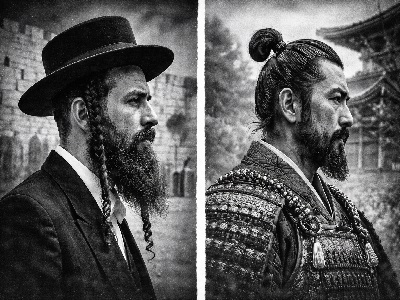 Japanese "Mizura" and Jewish Peyot Japanese "Mizura" and Jewish Peyot
The photo below (left) is a statue of an ancient Japanese
Samurai found in relics of the late 5th century C.E. in
Nara, Japan. This statue shows realistically the ancient
Japanese men's hair style called "mizura," which hair comes
down under his cap and hangs in front of both ears with some
curling. This hair style was widely seen among Japanese
Samurais, and it was unique to Japan, not the one which came
from the cultures of China or Korea.
Is it a mere coincidence that this resembles Jewish "peyot"
very much, which is also a hair style of hanging the hair in
front of the ears long with some curling (photo right)? "Peyot"
is a unique hair style for Jews and the origin is very old.
There is a statue from Syria, which is from the 8th or 9th
century B.C.E.. It shows a Hebrew man with peyot and a
fringed shawl. |
|
|
|
Did the Lost Tribes of Israel Come
To Ancient Japan?
The Land of Far End
There is a book called the Forth Book of Ezra, which was
written in the end of the first century C.E.. Although this
is not the Bible but just one of the ancient Hebrew
documents, an interesting thing is written:
"They are the Ten Tribes which were off into exile in the
time of King Hosea, whom Shalmaneser king of Assyria took
prisoner. He deported them beyond the River and they were
taken away into a strange country. But then they resolved to
leave the country populated by Gentiles and go to a distant
land never yet inhabited by man, and there at last to be
obedient to their laws, which in their own country they had
failed to keep. As they passed through the narrow passages
of the Euphrates, the Most High performed miracles for them,
stopping up the channels of the river until they had crossed
over. Their journey through that region, which is called
ARZARETH, was long, and took a year and a half. They have
lived there ever since, until this final age. Now they are
on their way back, and once more the Most High will stop the
channels of the river to let them cross." (13:39-47)
This article was mentioned in the form of a vision and we
cannot immediately think that this is a historical fact. But
it is possible to think that there was some fact which
became the background for this article. There might be the
news or oral tradition that the Ten Tribe of Israel started
their journey to the east and settled to a land of a year
and a half distance away.
Where is ARZARETH which the Ten Tribes are said to have gone
to? We cannot find the same name in the world by looking at
the map.
Dr. Schiller Szinessy suggests that this is nothing else but
the Hebrew words "eretz ahereth" (ARZ AHRTh) which means the
other land. Otherwise, if we interpret this as the Hebrew
words "eretz aherith" (ARZ AHRITh), they mean the end of
land, or most far away land. Not a few people thought that
Japan might be the land.
Japan Which Kaempfer Saw
Engelbert Kaempfer was a German medical doctor who stayed at
Dejima, Nagasaki Japan during 1690-1693 C.E.. He came to
Japan after he traveled and saw various countries of the
world. He was an erudite man and published a book about
Japan after he went back to Europe.
In the book Kaempher states that the Japanese language,
customs and religion are much different from the ones of the
Chinese or the Koreans, and that the main race of the
Japanese are not derived from the Chinese or Koreans but
rather a tribe from the area of Babylon came to Japan and
became the main race of the Japanese. He wrote:
"The Japanese must be of a tribe who immigrated directly
from the area of Babylon."
The area of Babylon is the Middle East where there was the
Assyrian Empire which the Ten Tribes of Israel were exiled
to. Kaempher also states:
"The appearance of the Japanese is so different according to
regions in Japan that we can clearly distinguish. This
proves that the Japanese are formed through the process that
several tribes were added to a basic nation. The most noble,
old lineage family and "daimyo", feudal lords, and high
officials are generally intelligent, elegant in appearance
than others, full of dignity, having higher nose and
somewhat look European. The people in the region of Satsuma,
Oosumi, and Hyuga are middle in the height, but strong and
manly in language and ability...."
And he states that there are differences in appearance and
nature according to the peoples of various parts of Japan.
He also states:
"As for the roots of the Japanese and their origin, it seems
that we should admit the Japanese are independent from
others and did not derived from the Chinese."
Rabbi Tokayer's Experience
Rabbi Marvin Tokayer tells a story about what he saw in
Japan. He lived in Tokyo, and on the first Sunday in Japan
he visited Meiji-jingu, a grand shrine of Shinto which is
the religion unique to Japan. There he saw a Shinto priest
wearing a white robe, putting a unique cap, and on the
corners of his robe were fringes which were cords of 20 - 30
centimeters long.
The Shinto priest was waving a branch of Sakaki tree to
right and to left and upward and downward. He was purifying
a baby of one month old who was brought to him by the
parents but never carried by the mother. When seeing this
scene, he says he thought:
"Did I come to my home land?"
Because all of these he saw were the customs of ancient
Israel. The way of waving the branch by the Shinto priest
resembled Jewish custom. And in ancient days of Israel, the
mother was considered impure, after birth, and would not
carry the baby for the ceremony in the temple. Today, Jews
no longer observe this ritual, but how fascinated he was to
see everyone except the mother holding the baby. He said,
"Cute." to the family and asked why the mother was not
carrying the baby, and his wife and he were stunned into
silence, when told that the mother was still impure, just as
the Bible.
He asked a Shinto priest, "Why do you put on fringes on your
robe?" The priest answered, "This is just a tradition from
ancient times." But this is originally the custom of Israel.
There is a description about the fringes in the Bible
(Deuteronomy 22:12).
Fringes were actually a trademark that he was an Israelite.
Today, Jews wear prayer shawl called Tallit which is a large
white cloth with fringes (called Tzitzit) on the corners.
These are the same as the ones of the Japanese Shinto
priest.
The Three Holy Objects in Israel and
Japan
Like the ancient Israelites had three holy objects, the
Japanese have three holy objests, which are a mirror (called
Yata-no-kagami), a bead (Yasaka-no-magatama), and a sword (Kusanagi-no-tsurugi).
These have been believed very holy as the tokens of
authority of the emperors and as the holy Yorishiro since
very ancient times. Today these three are kept separately in
different places.
There are several differences between the holy objects of
ancient Israel and the ones of Japan, but are common in
having three things and thinking them holy. Though in fact
the three holy objects of Israel were lost in the time of
Babylonian Empire, so it was impossible to have the same
objects in Japan.
An orthodox Shinto believer, a Japanese scholar and a
professor of Kyuusyuu Imperial University, Dr. Chikao
Fujisawa, believed that the three holy objects of Japan
originated from the three holy objects of ancient Israel.
And there are not a few Shinto scholars who think the same.
Some suggest a parallelism between the mirror and the
tablets, the bead and the manna, the sword and the rod.
Some point out that mirrors were also used in the temple of
King Solomon (1 Kings 7:28). Others point out that the shape
of the Japanese bead is the same as a Hebrew letter yod
which is also the first letter of the holy name Yahweh.
Offerings
To Shinto shrine people bring rice, Mochi (Japanese Matzah),
Japanese liquor (Sake), cereals, vegetables, fruits,
confectioneries, salt, water, fish (sea bream, etc.), and
bird (pheasant meat, etc.) as their offerings to god and
place them in the Holy Place of the Shrine. These must be
the best ones, and the fire for cooking them must be a holy
one lit by flint or heat of rubbing.
The offerings are displayed beautifully on a table of wood
and the priest prays to god in front of it. After the
ceremony the priest and participants are to eat the
offerings. In that, modern Shintoists find significance that
man eats with god or dines with god.
In the Holy Place of the Israeli tabernacle or temple, there
was also a table of wood on which the bread made of cereals
of the land, liquor (wine), and incense were offered (Exodus
25:29-30). These offerings to God had to be the best ones.
The priest prayed to God and after the ceremony the
offerings, which had been offered to God, were eaten by the
priest and his family (Numbers 18:11). And in the Bible
there is an article that Moses and the leaders of Israel
"ate and drank" in front of God on Mt. Sinai (Exodus 24:11).
The Bible does not mention the concept of "dining with God"
though, later, Jews in Talmudic times find significance of
dining with God.
With a few exceptions, meat of four legged animals is
generally not offered in Shinto religion. The most common
offerings are firstfruits, salt, fish as bonito, Mochi
(Japanese Matzah), rice, liquor (Sake), seaweeds, etc.
Usually most of them are Kosher, or permitted foods in the
Jewish diatary laws. But in modern Shinto, shellfish is
sometimes offerred (Abalone is offered at Ise grand shrine).
This is non-Kosher and the Jews not only never eat it, but
also never offer to God. How was it in the start of Japanese
Shinto?
In the Holy Place of the Israeli tabernacle or temple, there
were also lamps which were never extinguished (Exodus
27:20-21), since they were holy fire. There is also an
eternal light burning in every synagogue to this very day.
In the same way, in the Holy Place of Japanese shrine, there
is holy fire as lamps lit by divine means. Placing fire as
lamps and the table with offerings on it in the Holy Place
of the Shinto shrine resemble the Holy Place of ancient
Israeli tabernacle. Thus the functions of the Holy Place and
the Holy of Holies of the Japanese shrine are very similar
to the ones of ancient Israel.
It is noteworthy that the liquor is indispensable for both
Israeli and Japanese shrines. Like the liquor was offered in
the Israeli temple, the liquor is offered in the Japanese
shrine. The Bible says that the drink offering shall be of
"wine, one-fourth of a hin" (Leviticus 23:13). "A hin" is
about 6 liters, and I hear that its one-fourth is about the
quantity of the liquor which is offered in grand shrines of
Shinto.
Surprise of Chief Rabbi of Israel
Rabbi Marvin Tokayer, who used to live in Japan, tells a
story about when the chief rabbi of Israel, Shlomo Goren,
once visited Japan.
Chief rabbi Goren was very curious and fascinated with Japan
and enjoyed his stay very much. He said that he wanted to
learn the essence of Japanese Shinto religion, and he
attended for a while a lecture at Kokugakuin University
which is a Shinto university in Tokyo.
At the lecture, the chief rabbi asked the lecturer a
question about how to guard Shinto grand shrine, that is,
where the guards stand, how they patrol, in what turn they
patrol the places, and how to shift the guards. Hearing the
answer, Rabbi Goren was very surprised and said,
"Unbelievable." Turning his face pale, he said to Rabbi
Tokayer who was young in those days, "Do you understand the
importance of what the Shinto lecturer said?" Then he added,
"Read the Mishnah, and you will know why I was so surprised
to hear it."
The Mishnah, the teachings of ancient Jewish scholars, has
an explanation on how the ancient temple of Jerusalem had
been guarded. As a matter of fact, Shinto's way of guarding,
patrolling, and shifting guards at shrine are just the same
as the one which had been done at the ancient temple of
Jerusalem. The temple of Jerusalem was destroyed in 70 C.E.
and not yet rebuilt. How cound the way of guarding at
Japanese Shinto shrine be the same as the one at the temple
of ancient Israel? Chief rabbi's word "Unbelievable" is a
natural response.
Uncovered Dancing of David
In old Shinto shrines men often wear white robes to carry
the Omikoshi ark, while in other shrines men wear short and
colored garments with headbands and carry the Omikoshi very
cheerfully shouting "Wasshoi, Wasshoi". Around them people
in the same wear are dancing and sometimes we find half
naked ones. This reminds us of the scene of the dancing of
David.
David undressed the usual gorgeous robe for king, clothed in
a simple white linen robe and danced before the ark of God.
His wife Michal saw him and despised him in her heart. Later
she said an irony to David, "How glorious was the king of
Israel today, uncovering himself today in the eyes of the
maids of his servants!" (2 Samuel 6:20)
David did not become totally naked but he who usually wore
gorgeous robe danced wearing a simple white robe, which
looked almost uncovered or half naked to the eyes of Michal.
She would feel the same if she looked at the Japanese people
dancing.
Using Water and Salt for
Sanctification
In Japanese Shinto they have a custom to use water or salt
for sanctification.
Most of the Japanese shrines are built near clean river,
pond, lake, or the sea. This is to do sanctification there.
In Shinto, water is to purify man. In ancient Israel they
had this custom, for the Bible says that before priest
serves at holy events or at the temple, he has to "wash his
clothes" and "bathe in water" (Numbers 19:7).
So, it was also an ideal in ancient Israel that they have
clean water near a worship place. Japanese Shinto priests
also wash their clothes and bathe in water before they serve
at the shrine. Buddhist priests generally do not have this
custom.
In the Shinto religion they also use salt for purification.
Japanese Sumo wreslers sow the Sumo ring with salt several
times before they fight. The Western people wonder why they
sow salt, but the Jews get the meaning immediately that it
is to purify the ring. In Japan, salt is used to purify the
holy place of shrine, or to purify Omikoshi.
And when you go to a Japanese-style restaurant, you will
sometimes find some salt put near the entrance. The Western
people wonder why, but the Jews get the meaning immediately
that this is for purification. Even today, the Jews have a
tradition of welcoming a new neighbor or distinguished guest
with salt. If a world leader were to visit Jerusalem, the
chief rabbi would welcome him at the entrance to the city
with Hallah (Jewish bread) and salt.
Jews start each meal by salting bread, this makes every meal
table an altar. Meat is "Koshered" by putting salt on the
meat to remove all the blood.
In Japan they offer salt every time they perform a religious
offering. So is the offering at Japanese feasts. Salt is not
offered in Buddhism. Offering salt is again the same custom
used by the Israelites, for it is written in the Bible that
one has to offer salt with all his offerings (Leviticus
2:13).
In Judaism, salt is very essential. Talmud (the wisdom of
Judaism) confirms that all sacrifices must have salt. Salt
is preservative. While, honey and leaven were prohibited
with sacrifices since they symbolize fermentation, decay and
decomposition, the opposite of salt. There is the words "the
everlasting covenant of salt" in the Bible (Numbers 18:19).
Salt has meaning of anti-decay and permanence, and
symbolizes the everlasting holy covenant of God. The Temple
of Jerusalem had a special salt chamber, and Joshephus, a
Jewish historian in the first century C.E., records a Greek
king making a donation of 375 baskets of salt to the temple.
According to Zen'ichiro Oyabe, Japanese people before
Meiji-era had the custom to put some salt into baby's bath.
The ancient people of Israel washed a new born baby with
water after rubbing the baby softly with salt; there is a
description about "rubbing baby with salt" in the Bible
(Ezekiel 16:4). Salt has cleansing and hygienic power and
newborn babies were rubbed with salt.
Thus, there was the common custom of sanctification in both
ancient Israel and Japan, and for this sanctification water
and salt were used in both countries.
Uncleanness of the Dead
In Japan, salt in a pouch is distributed to participants of
a funeral. After the funeral, when the participants come
back and enter their houses, they have to be sprinkled on
themselves with the salt for purification. Ancient
Israelites who touched a dead body or went to a funeral also
had to be purified in a specific way; the Bible says that a
clean person shall take hyssop and dip it in the water,
sprinkle it on the persons who were at funeral , or on the
one who touched a bone, the slain, the dead, or a grave
(Numbers 19:18). Thus in Israel the person who touched the
dead had to be purified himself.
Even today, you find water outside a Jewish cemetery and
outside the home, so people who are returning from a
cemetery or funeral can wash their hands before entering the
house. Before one goes to a funeral, one prepares water
outside the home, so you can wash before reentering your
home. Also in Japanese mythology, it is written that deity
Izanagi went to the world of the dead (called Yomi in
Japanese) to take his dead wife back, and when he came back
from Yomi, he bathed in water of a river and purified
himself from the impurity of the dead. In addition this Yomi,
Japanese Shinto's world of the dead, is very much like Sheol
which is the world of the dead mentioned in the Bible.
The very important feature of Japanese Shinto is that it has
the concept of uncleanness or impurity of the dead. A house
which has the dead, or a person who went to a funeral is
said to have touched the uncleanness. The Western people do
not have this concept. This uncleanness is not material but
religious or ritual. This Shinto concept is the same as was
in ancient Israel, for the Bible says that the one who
touches the dead body of anyone shall be "unclean seven
days" (Numbers 19:11).
In Shinto religion, a person with his/her family dead or
relative dead is regarded unclean for a certain period. In
the period, the person cannot come to a shrine, which was
also a custom of ancient Israel.
Buddhist funeral is held inside temple, but Shinto funeral
is held always outside shrine not to bring impurity into it.
And the Shinto priest who participated the funeral does not
bring things he used at the funeral into the shrine. Even
when he has to bring in, he purifies them and then brings.
He has to purify himself, too. Also in ancient Israel,
funeral is never held at the temple.
The Bible records that the Israelites wept and mourned for
"30 days" at the death of Moses and at the death of Aaron
(Deuteronomy 34:8, Numbers 20:29). While a Japanese ancient
Shinto book called Engishiki, which was written in 10th
century C.E., set a period of 30 days for the uncleanness
that a person cannot participate holy events, and set a
period of 7 days for uncleanness of death of a fetus of
within three months and death of a person lacking a part of
the body. Thus, the Shinto concept of uncleanness of the
dead resembles the custom of ancient Israel.
Salt to Offensive Person
In old days, the Japanese had a custom to sow offensive
person with salt. When watching Japanese TV drama of Samurai
times, we sometimes see the scene of sowing offensive person
with salt.
This can be understood by Jews, since the Bible has an
article that an Israelite, Abimelech, caputured and
destroyed an enemy city and "sowed it with salt" (Judges
9:45). Salt is also a symbol of barren, death, and curse.
In Israel, there is a lake named Dead Sea, which is called
in Hebrew Salt Sea (Yam Ha-melech) since it has very high
density of salt (5 times as the ocean). No fish. The
surroundings are also covered with salt or rock salt. This
place is also the ruin of ancient cities called Sodom and
Gomorah.
Bathing
The Westerns use soap inside bathtub and enter the tub with
their bodies still unclean. But Jews never do this. They
wash their bodies and make themselves clean and then enter
ritual bath. Every Jewish community has a Mikveh, ritual
bath. Jews follow ritual of washing before entering the
Mikveh. Everyone from the Western is surprised to see the
washing before bath.
But this is the same as the Japanese custom of bathing.
When you get to a public bath in Japan, there you will see
that Japanese people wash their bodies and make themselves
clean before they enter the bathtub. This is the same in
their homes. European and American people do not have this
custom except for Jews.
The Japanese like cleanness very much. Many of them have a
bath everyday, make their clothes clean, and wash their
hands very often. This is a tradition from ancient times
In the 14th century of Europe, there was a big fatality of
plaque called Black Death and many people died, although
only a few Jews died. So, the people of Europe douted the
Jews and spreaded the groundless rumor that the fatality was
due to that the Jews sowed with poison. But the fact was
that the Jews liked cleanness very much, made their cloths
and houses always clean, have a bath, and washed their hands
very often. While most of the people except for Jews in
Europe had never experienced bathing even once in their
whole lives. The reason why perfume was developed in Europe
was the smell of their bodies.
But the Jews washed hands after going to restroom, after
going outside, and before every meal. That was why they
rarely became sick. The Japanese have had this same custom
since ancient times.
Pillars of Stone
It is also interesting to note that as the Japanese say "one
man, two men, three men..." when counting the number of men,
ancient Japanese people said when counting the number of
gods "one pillar of god, two pillars of gods, three pillars
of gods..." This way of counting gods is understandable to
the Jews, because the ancient Israelites set up pillars of
stone for their worshipping, and the pillars were associated
with gods.
In many places of Japan even today, there are religious
pillars of stone. For instance, in Kazuno city, Akita
prefecture, there is a big long natural stone standing at
the center of the surrounding stones. The pillar-like
natural stone which is placed in the back of Kashima shrine,
Ibaraki prefecture, is also regarded as a holy stone.
The way of setting up these pillars of stone is almost the
same as the pillars of stone discovered in Israel. This was
a custom which the ancient Israelites had. Jacob, the
ancestor of the Israelites, set up "a pillar of stone" to
worship God and "poured a drink offering on it" (Genesis
35:14).
As Jacob poured a drink offering on the pillar of stone,
Shinto priest pours a drink offering (Sake) on the pillar of
stone. Moses also set up "12 pillars of stone" near the
altar according to the 12 tribes of Israel (Exodus 24:4).
Thus, the pillars of stone were an element of worshiping God
Yahweh.
But in the latter days when idol worship came into Israel,
people inclined to use the pillars of stone as an element of
their idol worship. So, later, prophets of Israel blamed the
pillars of stone and rejected them. The Bible says
concerning when the people of the southern kingdom of Judah
degraded to idol worship that they built for themselves "high
places" and "sacred pillars" (pillars of stone, 1 Kings
14:23). The pillars of stone were used as pagan sacred
pillars. Many of these are discovered in Israel and look
similar to the Japanese pillars of stone.
In Japan, not only the pillars of stone, there are many
shrines with big holy natural stones or rocks. These stones
are thought to be objects where the spirit of god comes down
and sits. They are connected to worship.
This kind of stone was also seen in ancient Israel. The
Bible records that the first Israeli king Saul rolled a
great stone and made it an altar (1 Samuel 7:33). He brought
a big natural stone and made it a worship place. He used
natural stone because it was forbidden to use hewn stone for
an altar. The Bible says that when one makes an altar of
stone for God, he "shall not build it of hewn stones."
(Exodus 20:25)
Also in Japanese Shinto, the stone for worshiping is always
natural stone.
Altar of Earth
While, insead of stone, earth is sometimes used for
religious worship. Nihon-shoki records that the first
Japanese emperor Jinmu took earth from Mt. Ameno-kagu-yama,
made many bricks from it and made an altar for worshiping
gods. It seems that ancient Israelites also made altar from
earth, for the Bible says, "An altar of earth you shall make
for me (God)" (Exodus 20:24)
Altar could also be made of earth. In case of the altar made
of earth, it meant that it was made of bricks. The history
of brick is very old; in the Near East many bricks were
already used even in the time of the Tower of Babel, about
4000 and several hundred years ago (Genesis 11:3).
It seems that the Israelites sometimes made bricks from
earth and made altar of bricks. But compared with stone,
brick is weak and easily decomposed by time, so
archaeologists have not yet found altar of bricks in Israel,
but found in other Near East countries.
Bronze Serpent
When the Israelites were wandering the desert after their
exodus from Egypt, they met a flock of serpents and many
people were bit and died. The poison were very strong like a
fire. To save the people, Moses made "a bronze statue of
serpent" according to the commandment of God and set it on a
pole so that the people could look at it, and when one who
had been bitten by serpent looked at the bronze serpent, he
lived (Numbers 21:9).
After this incident ended, this bronze serpent had been in
the safekeeping among the Israelites. The exsistence of this
statue was never bad as long as the faith of the Israelites
were sound. But when the Israelites degraded later, they
began to worship the bronze serpent as their idol rather
than to worship true God. As a result Hezekiah, a king of
the southern kingdom of Judah in the 8th century B.C.E.,
broke the stature to stop the idolworship. The Bible records
that he broke in pieces the bronze serpent that Moses had
made; for until those days the Israelites "burned incense to
it" (2 Kings 18:4).
It was before this when the Ten Tribes of Israel were exiled
to Assyria (722 B.C.E.). So it seems that the Ten Tribes had
the custom of worshiping the bronze serpent when exiled.
At a Shinto shrine on Mt. Inomure, Ooita prefecture, until
about 40 years ago, there had been a unique feast for
begging rainfall, in which they firstly make a foundation by
constructing 6 trunks of tree into the shape of the Shield
of David, then on it they pile up a lot of branches and make
it a tower, and on top of it they put a vertical pole with a
slough of snake twining round it. People burn the branches
and the tower and pray for rainfall. They burn incense to
the snake expecting a supernatural power from it.
I saw the scene on a video and this reminds us of the custom
of ancient Israel to worship the bronze serpent. Besides,
gods which are worshiped in Japanese Shinto shrines are
sometimes snakes. This might have some connection to ancient
Israel.
Remnant of Celebration of
Circumcision
If the ancient Israelites came to Japan, do the Japanese
have the custom of circumcision? Although I have heard a
rumor that circumcision is performed among the Imperial
family of Japan, I have not been able to confirm yet whether
or not there was the custom of circumcision in Japan.
Today we cannot see the custom of circumcision among
Japanese citizens, but they have a traditional Japanese
custom called O-shichi-ya which means 7th night. On the 7th
night from the day a baby was born, the Japanese parents
have a celebration to introduce the baby to relatives and
friends and let them know the name of the baby.
The 7th night is, according to the Jewish way of counting
days, 8th day from the day the baby was born, for from the
sunset the next day starts in the Jewish calendar. Is this a
remnant of the Jewish custom of circumcision on the 8th day?
The Israelites gathered together on the 8th day from the day
a (male) baby was born, and the parents introduced the baby
to relatives and friends, circumcised him, introduced his
name and rejoiced his birth together (In case of a female,
it was done on the first Sabbath). This is the same in
modern Judaism. For the seven days, the baby has no name.
This is the same custom as the Japanese.
Customs of the First Month
The Japanese traditionally celebrate a new year
magnificently. They also do Obon feast on July 15 or August
15 every year as a national event. They have a saying, "It
is as if Obon and a new year came together" which means very
very busy. These two events are the most magnificent ones
throughout a year in Japan.
Looking at the new year first, on January 1 many Japanese
people begin to gather together at shrines even before dawn.
And on January 1 they sit a happy circle with family and eat
Mochi (Japanese Matzah). They eat Mochi for 7 days and on
the 7th day they eat porridge with 7 kinds of bitter herbs.
Today, the Japanese use the solar calendar; the New Year's
Day is January 1 and the day of eating porridge with 7 herbs
is January 7. But historically the Japanese used the lunar
calendar, when the New Year's day was the 15th of the first
month because on that day was the first full moon. It is a
remnant of this that today January 15 is called Small New
Year's Day (Koshougatsu in Japanese). This day was also
called "New Year's Day of Mochi". New Year's celebration was
a feast of Mochi. And the night of January 14 is called New
Year's Eve of the 14th Day. In the time of the lunar
calendar, the 15th day of the first month was a national
holiday.
According to Zen'ichiro Oyabe, the Japanese before the 12th
century C.E. had eaten porridge with 7 bitter herbs on the
15th day of the first month, and on the following days they
performed events to pray for good harvest of the new year.
This is similar to the custom in ancient Israel. They
celebrated the Feast of Unleavened Bread throughout the "7
days" "from the 15th day of the first month", when they ate
the unleavened bread (Leviticus 23:6).
The unleavened bread, which is "matzah" in Hebrew, is a very
thin bread prepared by kneading and baking without using
yeast or leaven. The way of preparing Japanese Mochi is
similar to this except for using rice instead of flour.
Israeli "matzah" and Japanese Mochi are very similar each
other in pronunciation as well as in meaning, recipe and
purpose.
And the Israelites ate with "bitter herbs" on the 15th day
of the first month (Exodus 12:8). Thus, just as the ancient
Japanese ate with 7 bitter herbs on the 15th of the first
month, the Israelites ate with bitter herbs on the 15th of
the first month.
In the Jewish calendar, the 15th day of the first month,
that is the first day of the feast, is full moon and the
Sabbath (Leviticus 23:7). On the next day of this Sabbath,
the Israelites offered firstfruits and prayed for a good
harvest of the year (Leviticus 23:11).
The Japanese clean their houses thoroughly before the coming
of New Year's Day. When the Jews look at it, they think,
"This is the same custom as ours!" for they also had to
clean their houses thoroughly before the Feast of Unleavened
Bread, for the Bible says, "you shall remove leaven from
your houses" (Exodus 12:15). So they had to purge all the
houses and remove leaven from them. Passover among the Jews
in India is called Holiday of Cleaning the House and they
remove all leaven and clean the house.
Obon Feast
Next, let us look at the Obon feast. In Japan they have an
event called Obon on July 15 or August 15. In the time they
used the lunar calendar it was held on the 15th day of the
7th month.
Today Obon is regarded as one of the events of Buddhism, but
since the time long before Buddhism was imported to Japan,
there had been a feast called Tama-matsuri which was the
original of Obon. When Buddhism was imported to Japan, this
Tama-matsuri was took in the events of Buddhism and became
Obon. In ancient Israel on the 15th day of the 7th month was
a big feast called the Feast of Booths (harvest feast,
Leviticus 23:39).
Today the Japanese use the solar calendar and in many cases
they now hold the Obon feast on the 15th day of the 8th
month. Strangely this was the day when the harvest feast was
held in the northern kingdom of Israel of the Ten Tribes.
The Bible records that Jeroboam, the king of the northern
kingdom, ordained a feast "on the 15th day of the 8th month"
like the feast which was in the southern kingdom of Judah (1
Kings 12:32).
It was an Israeli tradition since ancient times to have the
harvest feast on the 15th day of the 7th month, but King
Jeroboam rejected this tradition and ordained a new day for
the harvest feast on the 15th day of the 8th month.
In Israel, the Feast of Unleavened Bread (New Year) and the
Feast of Booths (harvest feast) on the 15th day of the 7th
month (or 8th month) were the most magnificent events
throughout a year. Similar to this, the Japanese have been
performing magnificent feasts at the same times as these. In
Japan today, the 15th day of the 8th month is also the
memorial day of the end of the last war.
Dancing at Obon
There is an interesting point in the Obon feast. The
Japanese dance at the feast and this is not a dance of
Buddhism but a traditional dance called Utagaki which has
existed since ancient times.
The Utagaki dance has been held since the time before the
5th century C.E. and became very popular in the 8th century.
Men and women gathered for dance and they sang, danced, met
with a view to marriage and promised to marry. Their way to
dance was that men and women joined alternately to a circle
of dancing, danced in the rhythm of song by a singer, and
when the number of people increased, they made the dancing
circle double or threefold.
The ancient Israelites also had this kind of custom. They
had a time of dancing during the harvest feast from the 15th
day of the 7th month (8th month in the northern kingdom),
and single men and women looked forward the time of dancing
and meeting to come.
I heard that in Japan there used to be a custom of plunder
marriage during the Obon feast. In Oita, Kyusyu Japan, there
was a custom that during many people are fanatical in
dancing, men took women they like and brought to forest. The
same custom was among the ancient Israelites.
The Bible records that there was an incedent that all of the
women of Benjamin tribe of Israel were killed, when the
elders of Israel talked each other how they can let Benjamin
tribe continue to exist. "There is a yearly feast in Shiloh
(a city in the northern kingdom of Israel)", the elders
said, and instructed the men of Benjamin, "Go, lie in wait
in the vineyards, and watch; and just when the daughters of
Shiloh come out to perform their dances, then come out from
the vineyards, and every man catch a wife for himself from
the daughters of Shiloh". The men did so. They "took enough
wives for their number from those who danced, whom they
caught" (Judges 21:16-23). Israel in those days was in such
a period of confusion.
Full Moon On the 15th Day
In Japan there is also a custom called Juugo-ya, which means
15th night, on the 15th day of the 8th month in the Japanese
old lunar calendar. This is during September-October in
today's solar calendar. This corresponds to the 15th day of
the 7th month (Tishri) in the Jewish calendar, which is the
day of the Feast of Booths. When the Japanese are
celebrating Juugo-ya, the Jews are celebrating the Feast of
Booths.
On this day, the Japanese often build a booth, gather
together there with family, put Japanese pampas grass to a
vase, offer harvest of the season like dumpling, taro, pear,
etc., and enjoy the beauty of the full moon in Autumn. In
Israel, on the 15th day of the 8th month in the northern
kingdom of Israel, or on the 15th day of the 7th month in
the southern kingdom of Judah, they built a booth, gathered
together there with family, offered harvest of the season,
rejoiced the harvest looking the beauty of the full moon in
Autumn (Leviticus 23:39-42).
Offering Harvest
In Japan they have an elegant custom to offer firstfruits of
harvest to god. They offer the firstfruits of cereals and
fruits or a part of what they first get from their
production.
Kanname-sai is a feast in October at Ise grand shrine to
offer firstfruits to god. The ancient Israelites also had
the custom of offering first fruits, for the Bible says that
the first of the firstfruits of the land shall be brought to
the temple (Exodus 34:26).
It is interesting to note that in Ise grand shrine in the
time of Kanname-sai feast, the clothes, tables, and tools
which are used in the service are all renewed. They do this
in the sense of coming into a new year. In Judaism also, the
month of the harvest feast (Tishri, September-October) is
the time of a new year.
About a month after the Kanname-sai feast of Ise grand
shrine, a feast called Niiname-sai is held at the Imperial
House of Japan. Although the name is different, this is also
the feast of offering a part of harvest.
Niiname-sai feast is held as follows; the feast begins at 6
p.m. and ends at around 1 a.m.. It is held at night. The
emperor offers the harvest to god and after that, he eats
them in front of god. By this ceremony the emperor is given
from god the role as the leader of the nation. In ancient
Israel, the leaders of Israel - Moses, Aaron, 70 elders,
etc. - also ate in front of God (Exodus 24:11).
And the Niiname-sai feast which the emperor performs for the
first time after he ascended to the throne is especially
called Daijou-sai feast which is a larger Niiname-sai feast,
when special booths are built for offering harvest. In the
Daijou-sai feast of today's emperor Akihito, there were also
simple but large booths built, and after the ceremony they
broke the booths and burned them.
Daijou-sai feast is also held at night. Akihito's Daijou-si
was held from 6:30 p.m. to the next morning. The emperor
offered the harvest and ate in front of god. In ancient
Israel and also today, the Jewish Feast of Booths begins at
sunset. The Israelites came into the booths, decorated with
harvest products, ate in front of God and rejoiced together.
Wedding
I find several similarities between the Japanese Shinto way
of wedding and the Jewish way of wedding.
In Shinto wedding, the bridegroom and bride drink from the
same cup of liquor (Japanese Sake). In the same way in the
Jewish wedding the bridegroom and bride drink from the same
cup of wine, although this is not Biblical but Talmudic (the
3-6th century C.E.). Christian wedding does not have this
custom.
In the Jewish wedding today, after drinking wine, the
bridegroom break a wine glass. This is to remember that the
Temple of Jerusalem is destroyed. This custom started after
the Temple of Jerusalem was destroyed in 70 C.E., and the
Israelites before that did not have this custom of breaking
the glass.
In Shinto wedding the bride has a shawl on her head and
hides half of her face. The shawl is to the hight of her
eyes today, but in old days, this was to hide all of her
face (called Kazuki in Japanese). In old days, this shawl
was also put when a Japanese woman attended a shrine.This
custom of shawl was also seen among the ancient Israelites.
In the Bible, Jacob, the ancestor of the Israelites, thought
that he had married Rachal though, the bride was in fact not
Rachal, but her sister Lear. It was due to darkness and the
shawl on her face that he could not distinguish her.
Even
today, Jewish bride puts a veil on her face in wedding .
Ancient Israeli woman had the custom to put a shawl and hide
her face when she comes out. Every time she comes to a
synagogue, she had to put a shawl on her head.
It is also an important feature of Shinto that every Shinto
priest is married. There is no rule in Shinto to make priest
single. In modern Japan, most of Buddhist monks are married
but this is a custom since Meiji-era. Before then, it was
the custom of Buddhist monks to be single. Every Buddhist
monk outside Japan is single. Catholic father is single. But
Shinto priest is married. This is a tradition from the time
immemorial. So was the ancient priest of Israel. So is rabbi
of modern Judaism.
Concerning Japanese marriage, a Japanese woman told her
memory. One day, her mother told her about the marriage of
her aunt. After the aunt's husband was killed in a war, the
aunt, who did not have any children then, married her
husband's brother who had been at that time unmarried. About
this marriage, the mother told her, "This is a traditional
custom of Japan," but then she thought that today is the age
of free love and it is consequential to marry whom one
loves, and she could not understand what the mother said.
However she told that later she was surprised knowing that
this is the same as a Jewish custom.
It is true that that this is the same as a Jewish custom,
for the Bible says that if brothers dwell together, and one
of them dies and has no son, the wife of the dead shall not
be married outside the family to a stranger; her husband's
brother shall go in to her, and take her as his wife, and
perform the duty of a husband's brother to her (Deuteronomy
25:5)
In Japan today, we cannot see this custom anymore usually,
but it seems that this custom had been performed widely in
Japan until recent time.
Various Other Similarities Between
Ancient Israel and Ancient Japan
Atonement
In Japan they have a traditional thought of atonement
similar to the one of ancient Israel.
In Old Shintoism, there is a ceremony of atonement called
Ooharai, which is a ritual to expel all the sins and
impurity of the nation.
In the ceremony of Ooharai, the emperor comes there wearing
a white linen clothes, which means a shabby figure. After
the ritual, the clothes are placed on a small boat and let
flow the river. People look at it flowing and vanishing from
their sight, when a prayer is chanted that the Imperial
Family of Japan came from heaven (Takama-no-hara or
Takama-ga-hara) and started to reign the country of abundant
nature, the archipelago of Japan, but there are many sins
raise up among the nation and we have to dispose them,
however these sins are strong and it is hard to dispose, so
we have to have specific days for atonement and the emperor
do a ritual of atonement and purification for the nation.
That is why the emperor performs a ritual of letting his
white linen clothes bear all the sins of the nation and
letting them flow the river to abandon.
And among the citizens, priests of shrines give all the
people's sins to white papers which are cut in the shape of
a man and let them flow the river. Ancient Japanese people
thought that they could not come into a new year without the
atonement of their sins. Ooharai atonement is held twice a
year on June 30 and December 31 every year at shrines and
the Imperial House of Japan.The Jews have actually two New
Year's Days in their Jewish calendar: One is the first day
of the seventh month, and another the first day of the first
month (the former is based on the creation of the world, and
the latter on the Exodus).
The thought of Ooharai is similar to the thought of the
Hebrew Scriptures. This Japanese custom resembles the
Israeli custom of the scapegoat, which was a ritual held by
the high priest of Israel at the temple of Jerusalem. The
high priest prayed laying his hands on the head of the goat,
let the goat bear all the sins of the people of Israel, took
the goat to a solitary land, and looked at the goat vanish
beyond the horizon, when the people were gratefull for that
their sins were took away with the scapegoat to a land which
cannot be seen and that God would not also look at their
sins anymore. This ceremony was held every year (Leviticus
chapter 16).
In Japan they also have a custom called Nagashi-bina, which
is an atonement ceremony to let dolls with sins attached
flow the river. Basically the concept of Japanese Ooharai
and Nagashi-bina seem to be similar to the concept of Jewish
scapegoat.
Furthermore, one Japanese Shintoist points out that the
kinds of sin mentioned in the prayer of Ooharai atonement
are very similar to the kinds of sin mentioned in the book
of Leviticus. In the prayer of Ooharai, the kinds of sin
mentioned are, "injuring a living person, injuring a dead
body, leprosy, hunchback, fornication with mother, rape of
one's own child, rape of mother and child, fornication with
animal, magic, etc.."
These are very similar to the kinds of sin mentioned in
Leviticus, which forbids the sins of injuring other person's
body or one's own body (19:28), and profaning the dead body.
The persons with leprosy (13:10-11), hunchback (21:20), or
other deformity could not serve at the temple of God
(21:17-23). Rape or fornication with mother, with one's own
daughter, or with animal are of course forbidden (18:6-23).
So is the sin of magic (Deuteronomy 18:11). Thus, the sins
mentioned in the prayer of Japanese Ooharai are very similar
to the ones mentioned in the Hebrew Scriptures.
Custom of Kanka and Jewish Passover
Jews have traditional custom called Passover. This
originates from the Book of Exodus in the Bible, and reminds
that more than 3000 years ago, the Israelites, who had been
slaves in Egypt, went out of Egypt under the leadership of
Moses. There was an incident called Passover at the night
just before they went out from Egypt. When occurred a
disaster of death upon the first son of every house in
Egypt, the disaster passed over all the houses of the
Israelites.
The Israelites killed lamb under the commandment of God and
put the blood to their gates. They soaked a bunch of hyssop
with the blood and applied it to the gates. The houses with
the blood were passed over by the angel of death. The
Israelites grilled and ate the lamb at the night.
The similar custom is seen in the area of Ryuukyuu, Japan.
As mentioned earlier, Juuji Nakada said that in Ryuukyuu,
there was a custom to drive all bad things away by killing
cattle and putting the blood to the gates of houses. This
custom is called Kanka. Nakada thought that the reason why
they used not sheep but cattle in Kanka custom was that
there were no sheep in Japan.
I called and asked the school board of Okinawa about this
custom. The answer was that they have in fact the custom
called Kanka or Shimakusarashi (meaning driving away). They
kill cattle, soak the blood with plant as Japanese pampas
grass or leaves of mulberry, and apply the blood to their
gates, four corners of their houses, and the entrance of the
village not to let bad things come in. They grilled and ate
the cattle on the day.
This reminds us of the custom of Passover in ancient Israel.
And I hear that the Japanese word Kanka means passover.
We can see the Kanka custom even today, but today in many
towns the cattle is replaced by pig. I asked "Why, pig?" The
answer was that in the past, they were prohibited to kill
cattle, so they changed to pig (There is an article in
Okinawa Daihyakka Jiten (Okinawa encyclopedia) published by
Okinawa Times).
Kanka custom is held mainly in the second month and eighth
month in the Japanese old lunar calendar (2-3 times a year).
The second month in the Japanese lunar calendar corresponds
with Spring - March or April in the solar calendar, and it
is interesting that this is about the same season as Jewish
Passover feast. According to the Bible, the lamb for the
Passover was killed on the 14th day of Nisan (Abib) in the
Jewish calendar, and this corresponds with March or April in
the solar calendar.
Putting off Shoes and Washing Feet
The Japanese emperor performs the Daijou-sai (the big
harvest feast) after his accession to the throne, when he
changes his clothes to white ones and come forward to god
with his feet naked. There he receives oracle of god and
becomes true emperor and leader of the nation.
This is similar to a thought in the Bible. When Moses came
forward to God, he put off his shoes and became barefoot
(Exodus 3:5). So did Joshua (Joshua 5:15). There they
received oracle of God and became true leaders of the
nation.
When the Japanese come into their house, they put off their
shoes, too. The Western and the Chinese come into their
house with their shoes on, but the Japanese do not.
According to Zen'ichiro Oyabe, until the beginning of
Meiji-era (about 100 years ago), there was a custom in Japan
to prepare a washtub with water or hot water for a person
who walked outside to wash his/her feet before entering the
house. Oyabe says that this is a traditional custom peculiar
to Japan and not the one they learned from other Asian
countries.
The ancient Israelites had the custom of washing their feet;
there are several descriptions about washing feet in the
Bible (Judges 19:21, etc.). Washing feet before entering a
house was a daily custom of the ancient Israelites.
Horses Dedicated to the Sun
In Japanese Shinto religion, the sun goddess Amaterasu is
worshiped as the ancestor deity of the Imperial House of
Japan and as the supreme deity for the nation of Japan. Ise
grand shrine is built for Amaterasu.
If you look at the inside of Ise grand shrine, near the
entrance you will find horses dedicated to the sun goddess
Amaterasu. These horses are not just ordinary ones but are
the horses which the Imperial House of Japan dedicated to
the sun goddess. The horses are to be put beautiful clothes
on, brought to a holy place of the shrine three times a
month and bow their heads to the sun goddess.
This is a tradition since ancient times in Japan, and also
in Israel, for the Bible records that King Josiah, of the
southern kingdom of Judah, removed the "horses" that the
kings of Judah had "dedicated to the sun" "at the entrance
to the house of the Lord", and he also burned "the chariots
of the sun with fire" (2 Kings 23:11). This horse dedication
is mentioned only once in the Bible, and it is amazing that
this ceremony also existed in Israel.
King Josiah, who reigned 639-608 B.C.E., did a religious
reformation and removed the custom to dedicate horses to the
sun. Until that time, such a pagan custom had been performed
throughout generations by kings. This was after the Ten
Tribes of Israel were exiled to Assyria. It seems that this
custom to dedicate horses to the sun had also been performed
in the northern kingdom of Israel, because pagan customs in
the southern kingdom were almost without exceptions
performed also in the northern kingdom. The custom of
dedicating the horses to the sun in Ise grand shrine might
originate from this.
And in many other shrines in Japan, you will find a place
where many plates of wood are hung, on which painted are
horses. Words of people's prayer are also written on them
and these plates are called Ema in Japanese meaning horse
painting. A priest of a shrine taught me that in old days
people dedicated a living horse but later it became
difficult to keep and was substituted by the custom to
dedicate the plates of horse painting.
Dedicating of horses was very common in Mesopotamia and this
could show a connection to Israel or its neighbors.
Celebration of Adulthood
In Judaism, when a boy becomes 13 years old, people have a
ceremony called Bar Mitzvah for his attainment of adulthood.
He receives much blessing from parents and relatives, and at
the same time starts to owe a responsibility as an adult and
religious duties. This ceremony is a great joy for both the
parents and him.
Bar Mitzvah is relatively a modern ceremony. The Bible does
not mention about this. The source is the Talmud
(established in 3-6 century C.E.) which states a boy of 13
is responsible to observe the commandments.
But it is interesing that also in Japan there has been a
custom of celebration of adulthood when 13 years old since
old days. In Japan, when a boy becomes 13 years old, there
was a custom (called Juusan-mairi) to attend a shrine or a
temple with his parents, brothers and sisters. It was a
general custom to celebrate his attainment of adulthood when
he becomes around 13 years old. In this ceremony (called
Genpuku-shiki), the boy comes in wearing an adult clothes
and be blessed as an adult. Sometimes the name for his
childhood is abolished and a new name for his adulthood is
given to him.
In an old Japanese book of life stories written in the 12th
century C.E., Soga-monogatari, it is written, "the brother
was celebrated his attainment of adulthood when he was 13
years old in the 10th month, became an adult, was given his
stepfather's name partly, and got called Sukenari Soga-juurou."
And Genta, a boy of the pedigree of Genji clan, was
celebrated his attainment of adulthood when 13 years old and
got a new name of Yoshiie Hachiman-tarou.
Similarity Between Japanese Mythology
and Religion of Baal
Japanese Shinto religion is polytheistic (belief in many
gods), while the religion of the Bible is monotheistic. You
may think that there is a definite difference between the
two. But different from the modern Judaism, religion in
which the ancient Israelites believed was not always
monotheistic.
They should have believed in one true God but sometimes they
adored idol-gods and became polytheistic. The ancient
Israelites believed not only in one true God Yahweh, but
also Baal, Ashtaroth, Molech and other pagan idol-gods. This
was true especially among the Ten Lost Tribes of Israel.
Shinto scholars say that a Shinto god Susanou (Susanou-no-mikoto)
in the Japanese mythology resembles Baal in several aspects,
and a goddess Amaterasu (Amaterasu-oomikami) resembles
Ashtaroth.
While in the Japanese mythology, the god which appeared
first is named Ameno-minaka-nusino-kami, who is the master
god living in the center of the universe, ruling the heaven
and the earth. He is invisible, has no shape, no dying,
individual, and the most central god of all. This god
somewhat resembles the God of the Bible. In fact, a
Shintoist Ikarimaru Watanabe (1837-1915), who is a desciple
of a great Shinto philosopher Atsutane Hirata, thought that
this god equals Yahweh, the God of the Bible.
In the Japanese mythology, after the first Shinto god
Ameno-minaka-nusino-kami, gods were born one after another
and one of them were Amaterasu and Susanou. The ancient
pagan religion of Baal, which the Israelites often inclined
to, resembled this. In the religion of Baal, for the master
god El, first invented was his "wife" Ashtaroth (Asherah) ,
and then the myth became that a son Baal was born to them.
Later people worshiped Baal who is a god of richness, and
Ashtaroth who is a goddess of productiveness and pleasure
rather than worshipping the master god El.
Thus the scheme that gods were born to the master god is the
same as the scheme of the Shinto mythology. It is possible
to think that the Japanese mythology includes a remnant of
the ancient religion of Baal.
Archaeologists state that the religions of Babylon and Egypt
had originally believed in one god called "the god of sky,"
who seemed to have a connection to the Biblical "God of
heaven." Later, their religions degraded to the polytheism.
I think that we can safely say the same thing happened to
the Shinto religion. I suppose that the ancient Shinto
religion had the belief in God Yahweh, but later degenerated
into polytheism. I believe that the Japanese people should
come back to believe in one true God whom the Bible teaches.
A Christian friend of mine, Mr. Tsujii, told me the
following incident. A friend of Mr. Tsujii's, who was a
passionate Shinto believer, came to him. The Shinto believer
had read the Torah and said excitingly:
"I read the Torah. I was very surprised to learn about the
religious ceremonies of ancient Israel. They are the same as
Shinto's. The festivals, the Temple, the value of cleanness,
all of those are the same as Shinto's!"
Then, Mr. Tsujii said to him:
"Yes, that is what I have also noticed. If you have
discovered it, why don't you believe in God whom the Bible
teaches? I believe that is the way to establish and recover
the true Shinto religion in which you believe."
Hearing this, the Shinto believer was too surprised to say
anything else for a while. Mr. Tsujii's words echo my own
belief. I pray that all Japanese people may return to the
belief in God of the Bible, because He is also the Father of
the Japanese nation.
The Renewal of Taika
In ancient Japan there was an awful conflict concerning the
reign of Japan between the Shintoists and Buddhists; so
called the conflict between Mononobe clan (Shintoists) and
Soga clan (Buddhists). Once the Buddhists had the power to
reign but later in the time of the Renewal of Taika (645
C.E.), the Shintoists recovered the power to reign. In the
Renewal of Taika we find appearance and disappearance of the
relation with ancient Israel because it was the time of
recover of the Shintoists.
For instance, the declaration of the start of a new age of
the Renewal of Taika by the new government was in the
beginning of the 7th month. The Japanese ancient chronicles,
Nihon-syoki, records that on the second day of the 7th month
they set a new princess and it seems that the first day of
the 7th month was actually the beginning of the Taika era.
The first day of the 7th month is the New Year's Day for the
Jews. They celebrate it (the first day of Tishri) as the New
Year's Day but it is the Sabbath, so they cannot work except
for religious things. It was the first day of the 7th month
that the priest Ezra let people listen to the Torah and
started his religious reformation among them in the 5th
century B.C.E. (Nehemiah 8:2). But except for this kind of
religious events, the official events must be from the
second of the 7th month.
And Nihon-shoki records that the new government sent
messengers "on the 14th day of the 7th month" to offer their
traditional religious offerings for Shinto gods. This is the
day, in the Jewish custom, to prepare for God the religious
offerings for a Jewish big feast, the Feast of Booths. This
coincidence is amazing.
This is not everything. In the Renewal of Taika, a new law
started for distributing lands to people. This law, which
continued until about 900 C.E., was that the government were
to redistribute lands to citizens every 6 years. The model
for this was a Chinese law but in the Chinese law the
redistribution was when a farmer became 60 years old or when
he died, and was not every 6 years. Then, why did the
Japanese government redistributed the lands every 6 years?
In ancient Israel, there was a law to use lands 6 years and
during the 7th year the lands had a rest (Leviticus 25:3-4).
This was to avoid continual farming and weakening of the
lands and it seems that this Hebrew law became a model for
the law of redistributing at the Renewal of Taika. Someone
guesses that the Japanese might used the 7th year for the
redistribution of the lands.
And in this redistributing, the size of the land was
determined according to the number of people of the family.
This was the same in ancient Israel, where the size of the
land of inheritance was determined according to the size of
the number of people of the tribe (Numbers 26:54).
The Imperial Edict of the Renewal of
Taika Resembled the Laws of Moses
Besides, among the laws which started at the Renewal of
Taika there are many which make us feel an association with
the laws of the Torah. For instance, in the Laws of Men and
Women of the Renewal of Taika, it is written that:
"Give the child who was born between a male slave and a
female slave to the mother, female slave."
This was the same in ancient Israel. The master gave the
child who was born between a male slave and a female slave
to the mother, female slave, and the male slave had to go
out alone (Exodus 21:4). And in the page of the Messenger at
the Renewal of Taika, it is written:
"Collect double from the one who got unjustly."
This means to collect double of the amount of money from the
one if he got something which is not his by lying that it is
his unjustly. This is the same as a law of the Torah, for
the Torah says that penalty for stealing is to pay double
(Exodus 22:9).
In the page of the Abolition of Old Customs at the Renewal
of Taika, it is written:
"Abolish the custom that a living person cuts his hair or
spears his thigh for the dead."
Among many nations are the custom that a living person
injures himself for the dead. In Taiwan, they have a
festival in which people injure themselves and shed blood.
It was true also in Japan but the Renewal of Taika forbad
it. This was the same as a law of the Torah, for the Torah
says that one shall not make "any cuttings in his flesh for
the dead", nor "tattoo" any marks on him (Leviticus 19:28).
Jews are forbidden by the Bible to cut the body and to tatoo.
Shinto priests do not tatoo nor cut the body. Also in the
laws of the Torah it was forbidden that a priest or a
citizen shaved the hair of the head (Leviticus 21:5, 19:27).
Buddhist monks shave their heads, but Shinto priests do not.
It is interesting to note that in the same page of the
Abolition of Old Customs, it is written about justice:
"Even if there are three definite witnesses, all should
state facts and then bring the case to the officer. Do not
sue recklessly."
Here why does it say "three definite witnesses"? It seems
that in this background is a thought that there should be at
least two or three witnesses, but even if in the case there
are three witnesses they should not sue recklessly; they
should state detailed facts before suing. This is associated
with a law of Moses, for the Bible says that one witness
shall not rise against a man concerning any iniquity or any
sin that he commits; by the mouth of "two or three
witnesses" the matter shall be established (Deuteronomy
19:15).
This is because the word of one witness could be a lie to
entrap the suspect.
Also in the page of Abolition of Old Customs, it is written:
"Until now there has been a trend that, for instance, during
a man entrusts a horse to a person, the horse dies
accidentally because of the person's fault, the man requires
too much compensation from him."
And the law of the Renewal of Taika forbad this kind of
requirement for compensation. This is the same spirit as
mentioned in a law of Moses, for the Bible says that if a
man delivers to his neighbor a donkey, an ox, a sheep, or
any animal to keep, and it dies, is hurt, or driven away, no
one seeing it, then an oath of the Lord shall be between
them both, that he has not put his hand into his neighbor's
goods; and the owner of it shall accept that, and "he shall
not make it good" (Exodus 22:10-11).
Thus the laws promulgated at the Renewal of Taika are very
similar to the laws of Moses.
The Study By Eiji Kawamorita
Dr. Eiji Kawamorita, who was a Christian pastor at a
Japanese church in San Francisco, paid attention to Japanese
traditional folk songs. He published several books about his
study on folk songs and insisted that many of the words in
Japanese traditional folk songs especially words of musical
accompaniment are Hebrew.
I have a letter of his hand writing, which shows how he was
eager with this issue.
For instance, what is the meaning of "Yah-ren so-ran" said
in a Japanese traditional So-ran folk song? What is "Yosah-koi"
said in Yosahkoi folk song? What is the meaning of "Nanyado
yara" said in a folk song in Tohoku area, Japan? If we read
them as Japanese, they have no meaning. But Kawamorita
insisted that if we read them as Hebrew, they would be very
meaningful.
Sometimes we find farfetched interpretation in his
explanation, but it is not easy to deny his insistence that
many Hebrew words are included in Japanese traditional folk
songs. To study this, scholars who are familiar with Hebrew,
ancient Hebrew, Aramaic and Japanese need to do a precise
study. I am pleased to learn that students are now studying
seriously the relationship of Hebrew words in Japanese.
The problem is that pronunciation of the folksongs has
changed during these several thousand years and we do not
know if today's pronunciation was the same in ancient times.
So When a Jew listens to Japanese traditional folksongs, it
is usually hard for him to recognize it as Hebrew. However
the theory of Kawamorita is interesting.
It is noteworthy that Kawamorita says that in the Japanese
folksongs the holy name of God (Yahweh) is used many times.
One of the differences between the Jews of the southern
kingdom of Judah and the Ten Tribes of the northern kingdom
of Israel is that the Jews of the southern kingdom started
to read God's holy name as the Lord (in Hebrew "adonai")
after the Babylonian exile (in the 6th century B.C.E.). This
was not to pronounce God's holy name unrespectfully; they
recited His name only in the temple, but since the
destruction of the temple in 70 C.E., they actually quit
pronouncing His name. While the people of the Ten Tribes
continued pronouncing His name. So, if it is true that God's
holy name is used and pronounced many times in the Japanese
folksongs, it would be possible to know that it was due to
the Ten Lost Tribes of Israel.
Did the Ancient Japanese Speak
Hebrew?
Not only it seems that there was Torah in ancient Japan, but
also there are some reasons to think that there were people
who spoke Hebrew in ancient Japan.
As "Hi, fu, mi..." mentioned earlier, in Kojiki, Nihon-shoki
and other ancient documents, we find many words similar to
Hebrew in both meaning and pronunciation.
For instance, the first Japanese emperor Jinmu gave leaders
of area the title "Agata-nushi"; "Agata" means area and "nushi"
means leader. Also in Hebrew "agudah" means group and "nasi"
means leader (In modern Hebrew it is nasi-agudah).
In Japanese an emperor is called with a title "mikado",
which sounds like Hebrew words "migadol" meaning the noble.
Every Japanese emperor is called with a title "mikoto",
which sounds close to a Hebrew word "malhut" meaning kingdom
or king. Every Japanese emperor is also called with a title
"sumera-mikoto", which has no specific meaning as a Japanese
word, but if we interpret it as a Hebrew phrase "shomron
malhuto", it means Samaria his kingdom or king of Samaria.
The ancient name for a Japanese Shinto priest is "negi",
while a Hebrew word "nagid" means leader.
The ancient Japanese name for a tomb of emperor or empress
is "misasagi", while a Hebrew word "mut sagar" means to
close the dead.
A researcher interpreted the Hebrew word for Canaan (ancient
word for the land of Israel) as a combination of "qanah nah"
which means field of reed, while the ancient Japanese called
their country "Ashihara" which means field of reed in
Japanese.
In the Japanese ancient books Kojiki and Nihon-shoki, we
find many other words which remind us of Israel. The ancient
name for an area in Nara prefecture is "Iware" which reminds
me of a Hebrew word "Ivri" meaning Hebrew. The ancient name
of a land in Nara prefecture "Asuka" resembles a Hebrew word
"ha-sukkah" which means the tabernacle. In Asuka was built
the ancient house of emperor. A Japanese scholar says that
"a" is a prefix and "suka" means tabernacle or dwelling.
Also in Hebrew "ha" is a prefix which means the, and "sukkah"
means tabernacle or booth.
Similarity Between the Stories of the
Bible and the Old Japanese Documents
We find several similarities between the stories of the
Bible and the stories of the old Japanese documents. For
instance, there is a similarity between Israeli King David
(the second king of Israel) and Japanese Emperor Sujin (the
10th emperor, 148-30 B.C.E.).
The Bible mentions that in the reign of King David, there
was a famine for three years (2 Samuel 21:1) and in the
following pestilence about seventy thousand people died
(24:15). While according to Nihon-shoki, in the reign of
Emperor Sujin there was a pestilence for three years and
about half of the people died. Both kings felt responsible
for these terrible sights, and required punishment from God.
David asked it through a prophet and Sujin asked through
divining.
Kojiki also records that Emperor Sujin did his fight in the
land of "Idomi", while the Bible records that King David did
his fight in the land of "Edom" (2 Samuel 8:14). Here we
find not only the similarity of pronunciations but also the
similarity of stories.
David's son was King Solomon, who built the first temple for
the heavenly God. While Sujin's son, Emperor Suinin, built
the first Shinto shrine named Ise grand shrine. There are
also some other similarities between the two kings.
Another interesting similarity exists between the King Saul
(the first king of Israel), and Japanese Emperor Chuuai (the
14th emperor).
The Bible records that King Saul was "a handsome man... and
taller than any of the people" (1 Samuel 9:2). While Nihon-shoki
records that Emperor Chuuai was "a handsome man and about
three meters tall." Both men were very tall and handsome.
King Saul came from the tribe of Benjamin. In the land of
Benjamin there is a famous town called "Anathoth". While
according to Kojiki, Emperor Chuuai reigned the country at "Anato",
which sounds close to Anathoth. King Saul fought Moab, whose
another name was Chemosh, in Hebrew "kemosh". This sounds
close to "Kumaso" tribe which Emperor Chuuai fought. Saul
died early because he committed a sin of disobeying the word
of God, while it is written that Emperor Chuuai also died
early because he disobeyed the word of god.
In addition, concerning the similarity between tribal names
in the Bible and Japanese mythology, one of the tribes which
ancient Japanese Yamato tribe fought is called the tribe of
"Emisi" or "Ebusu", which sounds close to the tribe name of
Jebusites, in Hebrew "yebus" (Joshua 15:63).
Similarity Between Japanese and
Hebrew
Joseph Eidelberg points out that there are many Japanese
words which are very similar to Hebrew in both meaning and
pronunciation.
A Japanese word "anata" which means you is also said "anta",
and in the dialect of Kyushu is said "atah". In Hebrew this
is also "atah" or "anta". "Aruku" in Japanese meaning to
walk is in Hebrew "halak."
Japanese "hakaru" means to measure and Hebrew "haqar" means
to investigate or measure. Japanese "horobu" means to perish
and Hebrew "horeb" means to become ruined or perish.
Japanese "teru" means to shine and Hebrew "teurah" means
illumination.
Japanese "meguru" means to circle and "magaru" means to
turn, while Hebrew "magal" means circle. Japanese "toru"
meaning to take is "tol" in Hebrew. Japanese "kamau" means
to mind or care and Hebrew "kamal" means to sympathize.
Japanese "damaru" which means to become silent is "damam" in
Hebrew. Japanese "hashiru" means to run and Hebrew "hush"
means to hurry. Japanese "nemuru" means to sleep and Hebrew
"num" means to doze.
Japanese "ito" which means thread is "hut" in Hebrew. The
stick with white papers of zigzag pattern put on its upper
part which the Shinto priest waves is called "nusa" in
Japanese, while a Hebrew word "nes" means flag. Japanese "ude"
means arm and Hebrew "yad" means hand. Japanese "kata" which
means shoulder is "qatheph" in Hebrew. Japanese "owari"
which means end or finish is "aharith" in Hebrew.
Japanese "kyou" which means today is "qayom" in Hebrew.
Japanese "tsurai" means painful and Hebrew "tzarah" means
trouble or misfortune. Japanese "karui" which means light in
weight is "qal" in Hebrew. Hebrew "qor" means coldness and
reminds of a Japanese word "kooru" which means freeze or
"koori" which means ice.
Japanese "samurau" means to serve or guard (for the noble)
and Hebrew "shamar" means to guard (Genesis 2:15). In
Japanese, from "samurau" came a word "samurai" which means
Japanese ancient warrior or guard. Also in Hebrew, if we
attach a Hebrew suffix "ai" meaning profession to "shamar",
it would be "shamarai" which sounds close to the Japanese
guard "samurai". [This is the same case as "banai" which is
a Hebrew word for builder and is a combination of "banah"
(to build) and "ai" (suffix meaning profession) . Modern
Hebrew does not have the word "Shamurai" but it fully
satisfies the grammar of Hebrew.]
Hebrew in Japanese
Researchers point out many other similarities between
Japanese and Hebrew. A researcher points out more than 500
similarities of words. Among them, there may be several
examples of similarity only by chance, even in those I
listed here, but can we think all of these are by chance?
There could be, by mere chance between two languages,
several words which resemble each other in pronunciation and
meaning, but when there are many words similar between the
two, we may have to think that there is etymologic
relationship between the two. Japanese includes many words
which seem to have Hebrew origin.
A person mentions about the Sea of Galilee in Israel and the
Sea of Biwa near Japan, which is the largest lake in Japan.
Biwa is the name of a musical instrument, lute or violin in
Japanese. While in Israel, there is a lake called the Sea of
Galilee which is almost the same in size and shape as the
Sea of Biwa. In the time of the Ten Tribes of Israel the Sea
of Galilee was called the Sea of Kinneret which is connected
to a Hebrew word "kinor" meaning lute or violin. So, if we
translate the Sea of Kinneret into Japanese, it would be the
Sea of Biwa (Biwa-ko).
There are some other popular etymologies, although not
scientific studies of linguistics. Nevertheless, many Jews
say when they come to Japan, it is a pleasant experience for
them to find familiar names in Japan.
The Japanese Who Used Hebrew
I have read an article written in English on a Jewish
newspaper published in 1913 before. The article was that,
when a Jew came to Kobe, Japan, he went in a curio shop and
was looking at the price of a vase. He found Hebrew letters
on the label of the bottom of the vase.
The Jews use Hebrew letters as numbers, too. For instance,
the first Hebrew letter aleph is 1, the second letter bet is
2, and so on. All other alphabets also correspond to
numbers. The Jew asked, "What are these letters?" The master
of the store said, "These are marks for a salesperson to
know the price. " The Jews asked, "Then, how much is this
vase?" The master answered, "5 dollars." "But why do you say
5 dollars, because it is written that this is 32 cents",
said the Jew. The master was surprised and said, "How did
you know that?" "It is written so in Hebrew here. Every Jew
can read it", said the Jew.
But the master looked that he did not understand what Hebrew
was nor the Jews nor Israel nor Judaism. He just told that
these letters were the numbers which had been passed from
generation to generation, from father to son since very old
days. The Jew asked him, "Do you have any other things which
have been passed from your ancestors?" The master showed him
some conical bells of silver, whick the Jew identified as
the ones to be placed on top of the Torah Scrolls.
The Kagome Crest at Ise Grand Shrine
While, you can see the same design as the Shield of David
(Star of David), the symbol of the Jews, in various places
in Japan.
In Mie prefecture, Japan, is located Ise grand shrine which
was built for the Imperial House of Japan, and a symbol
which looks very much like the Shield of David is carved on
all the lamps along the approaches to the shrine.
The Japanese call it Kagome crest, which means basket
reticulation in Japanese. This was named because the crest
looks like the reticulation of Japanese traditinal bamboo
basket.
The lamps at Ise grand shrine were built and offered from
the donators to the shrine after the World War 2. The Kagome
crest is also carved at a monument of Manai shrine, the
former (original) Ise grand shrine located in Kyoto. This
monument is also offered to the shrine.
In Japan, people have been using crests which look like the
Shield of David since very old days. For instance, Asa-no-ha
crest, which also resembles the Shield of David, has been
used widely as symbles for clothes since about Kamakura-era
(the 12-14th century C.E.). And Kagome crest was used by
Komiya clan and Magaribuchi clan, etc., who are descendants
of emperor Seiwa (the 9th century C.E.).
We can also see the symbols which resemble the Shield of
David as regalias of several cities of Japan. The city
regalias of Nishi-no-miya city (Hyogo prefecture), Oomuta
city (Fukuoka), Otaru city (Hokkaido), Wakkanai city
(Hokkaido), and Fukuchiyama city (Kyoto) are all in the
shape of 6 edged star, and resemble the Shield of David very
much.
But did they really originated from Jewish Shield of David?
Or, did they only happen to resemble?
You can recall the badge of American sheriff to be the same
design as the Jewish Shield of David, but it does not mean
that he is a Jew. The same thing could be said concerning
the crests in Japan. The design of six pointed star was used
widely in various countries from old days because of its
geometrical beauty.
In Israel, this symbol is discovered as a design without
national sygnificance in old remains; for instance, Shield
of David is discovered in a synagogue in Capernaum, Israel,
built in about second century C.E.. But it was only a design
and was not unique to the Jews. Even among other nations
than the Jews, this design It was since the 17th century
C.E. when this design started to be used generally as the
formal symbol for the Jews.
So, it is difficult to judge whether or not the Japanese
design of six pointed star originated from the Jewish Shield
of David.
Gion Festival
In 794 C.E., the government of Japan moved from Nara to
Kyoto. Just after the move of the government to the City of
Heian, a festival called Gion festival (Gion-matsuri) began
to be performed in Kyoto.
Even today the Japanese perform Gion festivals in various
places of Japan on July 17 or around that time. The center
of the festivals is Gion festival of Yasaka shrine in Kyoto.
The central event of Gion festival of Kyoto has been
performed always on July 17, or the 17th day of the 7th
month, since old days.
The important part of the festival is during 8 days from
July 17, and they also have important events on July 1 and
10. The 17th day of the 7th month mysteriously matches the
day when Noah's ark drifted ashore mountains of Ararat; the
Bible records, "the ark rested in the seventh month, the
seventeenth day of the month, on the mountains of Ararat"
(Genesis 8:4).
Since then, ancient Israelites might have had a thanksgiving
feast on this day every year, although there is no Biblical
record. Since Moses, it was replaced by the Feast of Booths
(Sukkot) which is performed on the 1st day, 10th day and
during 8 days from the 15th day of the 7th month.
Nevertheless, the Israelites knew well of the 17th day of
the 7th month to be the day when Noah's ark rested, because
it is written in the Bible.
Gion festival in Kyoto began in the wish that no pestilence
might occur among people. This resembles the circumstances
that when the temple of Jerusalem was established by King
Solomon, he had a festival in the wish that no pestilence
might occur among people. Solomon had the festival during 8
days (including the last day of solemn assembly) since the
15th day of the 7th month (2 Chronicles 7:8-10). There is a
difference of two days between Solomon's festival and Gion
festival but both were performed during 8 days in almost
same time of the year and in the same wish.
A Scottish businessman, N. McLeod, came to Japan in Meiji
era and saw Gion festival in Kyoto. He wrote that various
things in Gion festival reminded him of Jewish festivals.
At Gion festival, carpets, which were imported from Persia
and India via the Silk Road in the 16th century, are used as
the decoration for the festival cars even today. And
Japanese historians say that even in the times before it,
and since very early times, many naturalized foreigners
lived in Kyoto, which was indeed a big international city of
the world. Not a few Jews, who came via the Silk Road, seem
to have participated or enjoyed looking at the Gion
festival.
Gion festival always starts with a voice of "En yalah yah".
Even when we ask a Japanese person, "What does it mean?" he
only says, "I don't know." But to Jews this may sound like a
Hebrew expression "eni ahalel yah" meaning "I praise
Yahweh."
Sabato-yori and the Sabbath
In old days of Japan, there had been a remarkable custom
called "Sabato-yori" in Nagasaki.
"Sabato-yori" means "gathering of Sabato" and is a gathering
which the Christians gather together on every Saturday to
pray, eat, and talk together.
In Japan there was a long period of strong persecution
against Christians in Edo era and also in the beginning of
Meiji era. The custom of gathering of Sabato had been kept
continuously among the Christians who survived the
persecution. They gathered on every Saturday, as well as
Sunday which is the day for their mass.
About one hundred years ago in Meiji era, Christians who
survived were continuing this custom, and even old Catholic
believers in Uragami area of Nagasaki today have this memory
(there is an article about it in December 1963 issue of
monthly magazine "Taiyo"). According to them, this custom
had been widely seen in Japan before. It seems that the
origin is very old.
It may have some connection with the custom of the Sabbath
which Prof. Yoshiro Saeki mentioned was seen among the Eta
people in Nagasaki. I also recall that a Jewish traveler, S.
Levi from Tel Aviv in Israel reported in 1930' on an Israeli
news paper, Ha Aretz, that he saw in Japan the custom of the
Sabbath in a group.
The same custom of the Sabbath was seen among the Christians
in Nagasaki. In Hebrew the Sabbath is pronounced "shabbath"
and "Sabato" may be a slight corruption of it. The issue is
why they Christians have the custom of the Sabbath. Catholic
believers usually have no such a custom and this is a Jewish
custom. Nevertheless, how did they Christians begin to have
the custom of the Sabbath?
The Existence of Emperor
To think about the relation between Japan the Ten Tribes of
Israel, it is important to consider of the existence of
Japanese emperor. The Japanese emperor is not just a king,
but he is also a high priest. He is a priestly king. The
emperor is in a deep relation with Shinto and sits on the
central position of Shinto.
During the chapter 1-4, we saw about the Ten Tribes of
Israel in Afghanistan, India, Kashmir, Myanmar, and China,
but they did not have such a priestly king as the Japanese
emperor. How did Japan begin to have such emperor system of
single family line from generation to generation? . A
researcher thought that it was due to that the royal line of
Israelites came to Japan.
The ancient king of Israel was not just a king but also a
priestly king. Although there was a person called a high
priest as well as him, but the king of Israel often
participated in religious affairs. He was not just a
political king, but he often played a central role of
religious rituals. The king of Israel was, in a sense,
similar to the emperor of Japan.
After King Solomon died, in ancient Israel the royal line
was divided into two; one is took over by the southern
kingdom of Judah, and another by the northern kingdom of
Israel. In the southern kingdom, the royal line reigned the
country but lost its power after the Babylonian exile. Then,
how was it in the northern kingdom?
The first king of the northern kingdom was Jeroboam who was
from the tribe of Ephraim, and the last king of the northern
kingdom just before the Assyrian exile was Hoshea. According
to the Bible, all the kings of the northern kingdom
disobeyed the teachings of God, but among them Hoshea was a
better one, for the Bible records that he did evil but not
as the kings of Israel who were before him (2 Kings 17:2).
Hoshea and his staff members were exiled to Assyria in 722
B.C.E..
The royal line of the northern kingdom of Israel was
originally born in the rebellion against the royal line of
Judah. So it was very possible that after the exile they
thought to go to a distant land, rather than to go back to
Israel, and planned to make a country there and redo what
they could not do.
While, when did the Japanese emperor start to exist? It is
generally said that it was 660 B.C.E when the first Japanese
emperor Jinmu ascended the throne. The Imperial House of
Japan had already existed even before Hata clan first came
to Japan. Is the Imperial House of Japan in the lineage of
the Ten Lost Tribes of Israel, especially of its royal line?
The Formal Name for Emperor Jinmu
Concerning this, interesting is the similarity between
Ninigi and Jacob, between Yamasachi-hiko and Joseph, and
between Ugaya-hukiaezu and Ephraim as mentioned earlier
(chapter 8). This is a remarkable similarity in mythology
between the Imperial House of Japan and the royal line of
the Ten Tribes of Israel.
It is also interesting to note that the formal name for the
Japanese first Emperor Jinmu is called in Kojiki or in
Nihon-shoki:
"Kamu-yamato-iware-biko-sumera-mikoto"
Kanji letters are adopted in Kojiki and Nihon-shoki to this,
but this pronunciation had existed even before Kanji letters
were imported from China. So the Kanji letters have no
connection with the meaning.
This "kamu-yamato-...." has no satisfactory meaning if we
interpret it as Japanese, but Joseph Eidelberg interpreted
it as Hebrew. If we think of slight corruption and interpret
it as Hebrew, it would be:
"The founder of the Hebrew nation of Yahweh, the noble
(first born) of Samaria his kingdom."
This is not necessarily to mean that Jinmu himself was
really the founder of the Hebrew nation, but rather, it may
mean that the memory of the royal line of the Hebrew nation
coming to Japan was included in the legend of the Japanese
first Emperor Jinmu. Did the royal line of the Ten Lost
Tribes of Israel came to Japan? It is a grand mystery.
The Imperial Library Burnt Down
In Japan in 645 C.E., there was a very regrettable thing
that the Imperial library, which had kept very important old
documents and books, was all burnt down.
There was a fight between the pro-Shinto and the
pro-Buddhism and as the result, the pro-Buddhism, Soga clan,
set fire to the library, and all the important records and
books in it were burnt down.
The oldest book existing now among all the Japanese books is
Kojiki, but even this Kojiki was written in 712 C.E. which
was 67 years after the burnt down of the Imperial library.
That is, before Kojiki there had existed many ancient books,
records, and documents in Japan. In that library there was a
mountain of books older than Kojiki. They were all burnt and
lost. That is why the Japanese do not have any reliable
history before 8th century C.E..
Someone guesses that in the burnt library there was also the
Torah Scroll. We cannot deny the possibility if we think, as
we saw above, it seems that the laws of the Renewal of Taika
had a help from the knowledge of the teachings of the Torah.
If the ancient Japanese had the Torah, it must have been no
doubt kept in the Imperial library, which was unfortunately
burnt down. There must have been many other important
materials concerning the origin of the Japanese in the
library. The genealogy from their anscestors might also be
there. When the library was burnt down, the Japanese lost
their past.
In the 7th century B.C.E. in the southern kingdom of Judah,
a Torah Scroll was accidentally found in the temple when an
officer was searching gold in the temple (2 Chronicles
34:15). King Josiah at that time let a priest read the
Torah, when the king wailed and tore his clothes, for he
clearly understood that the people in the country were not
obeying the teachings of God.
We can know from this that the ancient people did not read
the Torah usually; the Torah Scroll was often kept in an
important place and no one looked at it. If the Torah Scroll
was in Japan, I wish it were found before it was burnt.
But even if the Japanese lost their past, we do not need to
say that now there is no way to know the past or origin of
the Japanese. I hear that the insides of many of the tombs
of the Japanese emperors are not yet researched or
exhibited. When they are researched, I believe we can know
more about the roots of the Japanese. The insides of tombs
of Egyptian kings are well researched and exhibited. If the
tombs of the Japanese emperors are researched scholarly, it
may be possible that the Japanese take their past back.
Even the day may come when a definite evidence would be
found in a tomb. Someone guesses the Israeli Menorah would
be found. Other person guesses the emblems of the Lost
Tribes of Israel would be found. Would such a day come?
Arinori Mori Who Saw the Holy Mirror
Lastly, let us look at the people around the mirror of Yata
(Yata-no-kagami) which is the holy treasure of Shinto and
one of the three holy treasures of the Imperial House of
Japan.
Arinori Mori (1847-1889) was the Minister of Education,
Culture and Science of Japan in the Meiji-era. He insisted
he saw that on the mirror of Yata in Ise grand shrine was
written in Hebrew "eheyeh asher eheyeh" which is God's name
written in Exodus 3:14 of the Bible and means "I AM THAT I
AM."
The mirror of Yata is the treasure which has been handed
down in the Imperial House of Japan since very ancient
times. The real one is kept at Ise grand shrine and a
replica at Kashiko-dokoro in the Imperial Palace. General
people cannot look at it because it is regarded very holy.
But we know the approximate size, for in an old record is
written the size of the case which has caliber of 49
centimeters. So, the mirror of Yata is imagined to be about
that size.
But the mirror of Yata is said that even the emperor is not
permitted to see. So must be the priests of Ise grand
shrine. Nevertheless, how could he look at it? We do not
know the details. But anyway the rumor that "I AM THAT I AM"
is written in Hebrew on the mirror of Yata spread at once
among people.
Another rumor is that just after Japan was defeated at the
World War 2, a general of GHQ forced and looked at the
mirror of Yata. One more is that Prof. Sakon from Aoyama-gakuin
University looked at the replica of the mirror in the
Imperial Palace and confirmed it.
In 1952, a group for friendship between the Japanese and the
Jews was organized under the leadership of a former navy
colonel, Koreshige Inuzuka. This was to study the relation
between Japan and Israel and to aim at the friendship
between the two. The meeting of the group on January 25,
1953, was held at the house of a Jew, Michael Kogan, in
Tokyo, and in the meeting was also Highness Mikasa, a member
of the Imperial family. The topic of the Hebrew words on the
mirror of Yata was raised in the meeting and Mikasa told
that he would check the truth.
But it was a start of the latter sensation, for a chief of
the branch office of Tokyo Evening News was at the meeting
and published an article about it on the next day's
newspaper titled "Mikasa Will Check the Hebrew Words on the
Holy Mirror!" This article became a topic among people in
those days and spread even abroad.
Yuutarou Yano Who Copied the Pattern
of the Mirror of Yata
However, the truth concerning the Hebrew words on the mirror
of Yata did not become clear.
Soon, one more person who insisted saw the mirror of Yata
appeared. He was Yuutarou Yano who was an elite officer and
a passionate Shintoist. He thought that the key to know the
truth about the emperor of Japan exists in the mirror of
Yata. Yano asked a priest at Ise-jingu again and again if he
could look at the mirror sincerely. He says that the priest
moved by Yano's passion, secretly permitted him to look at
the mirror, and Yano carefully copied the pattern of the
back of the mirror.
This copy has been maintained for years in a Shinto group
named Shinsei-Ryujinkai which is run by Yano's daughter. It
had been held in secret by the group. But later they say
that there was "god's revelation" to show the copy to the
world.
Even I could get a xeroxed copy of the pattern because a
friend of mine brought it to me. I saw the letters on it
which looked ancient and mysterious, especially the letters
inside the central circle looked somewhat Hebrew, for
instance, which means Light of Yahweh.
While, Yano himself did not think of these letters Hebrew,
but thought that these were a kind of ancient Japanese
characters called Jindai-moji. But there is a contradiction
in his interpretation to think of these as Jindai-moji,
because same letters appear in several places and he
interpreted them as different letters. And I have never seen
any Jindai-moji written horizontally.
Then, can we read them as Hebrew? Some resemble Hebrew but
others do not. How about Aramaic, especially ancient Aramaic
in Assyria? If someone knows well, please let me know.
We do not know for sure also if this copy is really the
pattern of the mirror of Yata. After all, the secret of the
mirror of Yata remains as a mystery. We need a photo of the
mirror to elucidate the mystery but it would be impossible
as far as people think this is taboo.
Anyway, the country called Japan is filled with interesting
topics concerning the relation with ancient Israel.
From the Study of Blood Types and DNA
Professor Tanemoto Furuhata, who is the authority on
forensic medicine at Tokyo University wrote in his book that
surprisingly, the blood types of the Japanese and the Jews
are very similar. I also heard that a professor at Paris
University had discovered that the "Y" chromosome of the
Japanese is the same size as that of the Jews. Recently
Prof. Satoshi Hourai, DNA scientist, investigated the DNAs
of the Chinese, the Koreans and the Japanese, and claimed
that the characteristics of about 26 percent DNA of the
Japanese are rarely seen among the Chinese or the Koreans
and unique to the Japanese. He says it shows that the
Japanese consist of various nations who came from the Silk
Road other than the Chinese or the Koreans.
I expect that further research will be done by many
individuals. |
|
|
Additional Reading |
|
|
|
|
|
Related Reading |
|
|
The Ten Lost Tribes of Israel In
Afghanistan, Pakistan, Kashmir, Myanmar, and China
What Are Israelites?
Around the time of 1900 B.C.E., there was a man named Jacob
who was the ancestor of the people of Israel. Later Jacob's
name was changed to Israel.
Israel had 12 sons, who were Reuben, Simeon, Levi, Judah,
Zevulun, Issachar, Dan, Gad, Asher, Naphtali, Joseph, and
Benjamin. The descendants of these sons formed 12 tribes of
Israel. These 12 tribes are called "Israelites".
When they had territories in Canaan (Israel, Holy Land), the
tribe of Levi did not have a territory for they were the
tribe of priests. Instead, the tribe of Joseph was divided
into the tribes of Ephraim and Manasseh and have their own
territories. Thus the land of Canaan was divided into 12
territories.
Later, the 12 tribes of Israel experienced the height of
prosperity in the time of King Solomon in the 10th century
B.C.E.. But after Solomon died, the united kingdom of Israel
was divided into two countries: One is the Northern Kingdom
of Israel and the other the Southern Kingdom of Judah. The
Northern Kingdom is also called Samaria, the Southern
Kingdom is also called Judea.
The word "Jews" is used basically for the people and
descendants of Judea, the Southern Kingdom, but sometimes
used for the same meaning as Israelites.
The Ten tribes of Israel belonged to Samaria, the Northern
Kingdom of Israel. They were Reuben, Gad, Ephraim, Issachar,
Zevulun, Naphtali, Asher, Dan, Manasseh and (a part of)
Benjamin. While the other tribes belonged to the Southern
Kingdom of Judah.
In the 8th century B.C.E., the Northern Kingdom of Israel
was conquered by the army of Assyrian empire, and the Ten
Tribes of Israel was led captive and compelled to march to
the land of Assyria. They did not come back to the land of
Israel. They are so called "the Ten Lost Tribes of Israel."
Josephus Wrote About the Lost Tribes
of Israel
Where was the exact place of the Ten Lost Tribes of Israel
to be carried captive in Assyrian Empire? The Bible records:
"the king of Assyria carried Israel away captive to Assyria,
and put them in Halah and by the Habor, the River of Gozan,
and in the cities of the Medes." (2 Kings 18:11)
These places are located in today's northern Iraq or
Northwest Iran called Kurdistan. The Ten Tribes of Israel
were firstly compelled to emigrate there, and this is also a
starting point of our research.
There is a Jew named Josephus Flavius, a very reliable
historian who lived in the first century C.E.. In his book
of history, there is a description about whereabouts of the
Ten Tribes:
"...the Ten Tribes who are beyond the Euphrates till now,
and are an immense multitude, whose numbers cannot be
estimated." (Antiquities 11:2)
Josephus wrote that in the first century C.E., the Ten
Tribes of Israel lived as an immense multitude beyond
Euphrates River. This may mean that some of of them lived in
the close area east of Euphrates River and others moved to a
place far beyond east of the Euphrates.
The Lost Tribes of Israel in
Afghanistan
The Bible mentions the cities of Medes, today's Iraq and
Iran, as the locations of the Assyrian exile of the Ten
Tribes of Israel. It is an accepted tradition that the
people of this area are from the Assyrian exile.
It seems that later, many of the Ten Tribes of Israel moved
to the east along the Silk Road. We find the descendants of
them in Afghanistan, Pakistan, Kashmir, Myanmar (Burma),
China and other countries, which are along the Silk Road. I
will have a brief explanation about them in this chapter.
The information is mostly from the books which were written
by Rabbi Marvin Tokayer and published in Japan, and "Beyond
the Sambatyon, The Myth of The Lost Tribes" written by
Simcha Shtull.
East of Iran is Afghanistan. There are so many tribes in
Afghanistan with names that have Yusuf in the name as
Yusufzai, Yusufuzi, Yusufzad, etc.. Yusuf means Joseph and
Yusufzai means children of Joseph.
They claim their origin to be from the Lost Tribes of
Israel, that is, from the tribes of Joseph, which are the
tribes of Ephraim and Manasseh and are a part of the Ten
Lost Tribes of Israel. They also call themselves Bani-Israel
meaning children of Israel. Their tradition is that they
were carried away from their ancient homeland.
Formerly they were shepherds in search of pasture but they
gave up their nomadic life and settled into village
communities. The people of Yusufzai live separated from the
rest of the world by mountains and difficult rivers and it
is hard to find them. They marry among themselves.
Today they are devout Muslims but have Hebrew names, wear
the fringes which only Jews and Japanese Shinto priests
wear, light candles for the Sabbath on Friday night which
only Jews do (The Sabbath is from the sunset of Friday until
the night of Saturday). They also have the custom called
peyot (side-curls) which is to have curled hair of about 10
centimeters long in front of both ears. This is a custom
which only Jews have and which may very well be of the Lost
Tribes of Israel.
Pathans As the Descendants of the
Lost Tribes of Israel
In Afghanistan and Pakistan, there also live people called
Pathans numbering about 15 million. They live mainly in
Pakistan and Afghanistan as well as in Persia and India.
Most of them are Muslims but they have a tradition of being
of the Lost Tribes and have Israeli customs.
According to a book written by Rabbi Marvin Tokayer, the
Pathans have custom of circumcision on the 8th day. This is
a known Jewish custom, and is the oldest Jewish tradition.
Rabbi Tokayer once told me that he had witnessed and been
present at a very joyous circumcision ceremony on the 8th
day after birth among the Pathans. Muslims have custom of
circumcision but it is not on the 8th day, usually at the
age of 12.
The Pathans have a sort of small Tallit called Kafan. This
is a 4 cornered garment which they tie strings similar to
the fringes (Jews call them Tzitzit) and is one of the
oldest Jewish traditions going back to the Torah and it is a
sign of their Israeli origin.
The Pathans have custom of the Sabbath, Israeli tradition of
the day of rest. On the Sabbath they do not labor, cook or
bake. The Pathans prepare 12 Hallot (traditional Jewish
bread, Leviticus 24:5) in honor of the Sabbath as was done
in the ancient Israeli temple. One of the significant
indicators proving the Israeli origins of the Pathans is the
lighting of the candle to honor the Sabbath. After lighting,
the candle is covered usually by a large basket. The candle
is lit by a woman past her menopause. This is the same as
Israeli custom.
Pathans have custom of Kosher, diatary laws same as Jews.
Pathans do not eat horse or camel meat, which is most common
in their area but forbidden to Jews. There is some evidence
to their not eating meat and milk together which is also an
ancient Israeli tradition. And they have a tradition
regarding differentiating between pure and impure birds
which means permitted and not permitted birds similar to the
Torah.
Some still wear a small box which Jews call Tefillin
(phylactery) containing a verse of the Bible. This box
resemble Japanese Tokin of Yamabushi's forehead, too, which
I will mention later. This is an ancient custom of Israel.
In the Jewish box there is the verse of Shema Israel, that
is, "Hear, O Israel: The Lord our God, the Lord is one!"
(Deuteronomy 6:4) This custom of Tefillin came from a verse
of the Scriptures, "You shall bind them as a sign on your
hand, and they shall be as frontlets between your eyes"
(Deuteronomy 6:8).
It is interesting to note that the Pathans retain family
names of the Lost Tribes such as Asher, Gad, Naphtali,
Reuben and Manasseh and Ephraim. Among them there are people
who are called by these names, which are of the Ten Lost
Tribes of Israel. There are also people who are called
Israel, Samuel, and so on, which are never found among the
Muslims.
The Pathans were mostly called "Bani-Israel" meaning
children of Israel even though they live today as devout
Muslims.
The legal system which is known as Pashtunwali, the law of
the Pashtu, is very similar to the Torah, which is the
holiest Jewish book and the book of ancient Jewish way of
life. There are pages and even complete books among the
pathans and they honor greatly what is called Tavrad El
Sharif (the Torah of Moses), and they rise at the mention of
the name of Moses even though it is not important in Islam.
Besides the oral tradition related by the elders of the
tribe, there are also interesting testimonies of keeping of
scrolls of genealogy among the tribes, reaching back to the
Fathers of the Jewish nation. These scrolls are well
preserved and some are written in gold on the skins of a
doe.
No less interesting and significant are the names of the
tribes which bear close resemblance to the Tribes of Israel.
The Rabbani Tribe is really Reuben, the Shinware Tribe is
Simeon, the Lewani Tribe is Levi, The Daftani Tribe is
Naphtali, and the Jaji Tribe is Gad, and the Ashuri Tribe is
Asher, The Yusefsai Tribe is children of Joseph, and the
Afridi Tribe is really Ephraim. These are the names of the
Ten Lost Tribes of Israel.
The Pathans themselves point out the differences between the
original names of the tribes and their present names are
because of the different dialects of the languages so that,
for instance, Jaji was actually called Gaji for the tribe of
Gad.
Women of the Pathans keep laws similar to the Jewish laws
regarding menstruation. During this time and for 7 days
after, no contact is allowed with the husband. After this
period, the woman immerses in a river or spring or in a
bathhouse if a natural spring is not available. This is
exactly the same as the Israeli tradition going back to the
days of the Bible.
The Lost Tribes of Israel Who Came to
Kashmir
Leaving Afghanistan and Pakistan where the Pathans live,
when one goes east, it is the State of Kashmir in northern
part of India which is west of Nepal.
There are 5 to 7 million people there. Generally speaking,
they have clearer complexions and are different from the
other citizens of India. An Interesting tradition is passed
down among the Kashmiri people regarding their ancestry from
the Lost Tribes of Israel.
The people in Kashmir perform a feast called Pasca in
Spring, when they adjust the difference of days between the
lunar calendar and solar calendar and the way of this
adjustment is the same as Jewish. Several books are
published on this. The Udu language which is used in Kashmir
includes many words of Hebrew.
In Kashmir, various places are called with Israeli names,
like Har Nevo, Beit Peor, Pisga, Heshubon. These are all the
names in the land of the Ten Tribes of Israel.
The same thing is true in the names of people, male names,
female names, and names of village. For example, one of the
tribes of Kashmir is called Asheriya which is Asher, the
tribe of Dand is Dan, Gadha is Gad, Lavi is Levi. The Tribe
of Shaul is the Hebrew name of King Saul. Musa is Moses,
Suliamanish is Solomon. And you also have the tribe of
Israel, the tribe of Abri which is the tribe of Hebrew, and
the tribe of Kahana which is the word for Jewish priest.
There are also 50-75 names of places in Kashmir which are in
fact the Hebrew names that ancient Israelites were very
familiar with. There is a place called Samaryah which is
Samaria. Mamre is Mamre, Pishgah is Pisgah, Nabudaal is Mt.
Nevo, Bushan is Bashan, Gilgit is Gilgal, Heshba is Heshbon,
Amunah is Amon, Gochan is Goshen, Median-pura is Midian, and
Guzana is Gozan which is a place name in Assyria and the
very place where the Ten Tribes of Israel were deported.
The name Israel is very common among them as it is among the
Pathans, and this name is never used among the Muslims.
The history of the Kashmiris is shrouded in mystery as is
the history of other people in that region. Most Kashmir
researchers are of the opinion that many inhabitants of
Kashmir are descendants of the Lost Tribes who were exiled
in 722 B.C.E.. They wandered along the Silk Road into the
countries of the East, Persia and Afghanistan until they
reached the Kashmir valley and settled there.
The priest Kitro in his book, the General History of the
Mughal Empire, said that the Kashmir people are the
descendants of the Israelites. The priest Monstrat said that
in the time of Vasco da Gama in the 15th century, "all the
inhabitants of this area who have been living here since
ancient times can trace their ancestry, according to their
race and customs, to the ancient Israelites. their features,
their general physical appearance, their clothing, their
ways of conducting business, all show that they are similar
to the ancient Israelites."
Among Kashmiri people there are customs to light a candle
for the Sabbath, have sidelocks, beards, and emblem or
design of the Shield of David (Star of David) just like Jews
do.
In an area which is on the border of Pakistan, called
Yusmarg (Handwara), there lives a group which to this very
day calls itself B'nei Israel meaning children of Israel.
Many of the inhabitants of Kashmir say that this is the
ancient name of all the people of Kashmir. The two primary
historians of Kashmir, Mulla Nadiri, who wrote The History
of Kashmir and Mulla Ahmad who wrote Events of Kashmir have
established without a trace of doubt that the origins of the
Kashmiri people are to be found in the people of Israel.
In Kashmir there is a strange legend which says that Jesus
did not die on the cross but in his search for the Ten
Tribes reached the Kashmir valley and lived there until his
death. They even point to his grave in Kashmir.
This is very much like a legend which exists in Japan (Herai
village, present Shingou village in Aomori prefecture),
where they also have the legend that Jesus came to Japan and
died there. They even point to his grave. It seems that
sometimes the legend of coming of Jesus and his tomb is born
where the Ten Tribes are said to come.
In Kashmir, there is another strange tradition of a small
community next to the Wallar Link who point out the grave of
Moses. There is yet another tradition in connection with
King Solomon according to which even King Solomon reached
the Kashmir Valley and through his wisdom aided the people
of Kashmir by successfully regulating the Jalum river. This
tradition is also connected to a place called Solomon's
throne which is situated above the capital of Kashmir,
Srinagar. Isn't it strange and fascinating that there are
historical and even folkloristic tales of ancient Israeli
heroes in these strange and exotic places?
These also strangely resemble the legends of Japan. There is
so called the grave of Moses on Mt. Houdatsu in Ishikawa
prefecture, Japan, and also a legend says that many secret
treasures of Solomon are kept in Mt. Tsurugi in Shikoku,
Japan. What is this phenomenon?
The Lost Tribes of Israel Who Came to
India and Myanmar
In the mountainous region which lies on both sides of the
border between India and Myanmar (former Burma), lives the
Menashe (Shinlung) tribe which numbers between 1-2 million
people. They intermarried with the Chinese and look Chinese-Burmas,
but the entire tribe is conscious of their Israeli ancestry.
Recently, Rabbi Eliyahu Avichail, who is the president of
Amishav, an organization in Jerusalem for the search of the
Ten Lost Tribes of Israel, went to Myanmar and investigated
the Menashe tribe.
The word Menashe appears often in their poetry and prayer.
It is the name of their ancestor and they call themselves
children of Menashe (Beni Menashe). When they pray, they
say, "Oh, God of Menashe," which is from the name Manasseh,
a tribe of the Ten Lost Tribes of Israel.
According to the history which Menashe people say, they were
exiled to Assyria in 722 B.C.E. with other Tribes of Israel.
Assyria was later conquered by Babylon (607 B.C.E.), which
was later conquered by Persia (457 B.C.E.), which was later
conquered by Greece of Alexander the Great (331 B.C.E.),
when the people of Menashe were deported from Persia to
Afghanistan and other places.
There Menashe tribe became shepherds and Idol worshipers.
They were later conquered by Islam and forced to convert to
Islam. Because of their speaking Hebrew they were called the
Semitic speakers. Throughout this entire period they
possessed a Hebrew Torah scroll which they guarded with
their elders and their priest.
Among them there were those who left Afghanistan and
migrated eastward until they reached the area of the
Tibetan-Chinese border. From there they continued into China
following the Wei River until they reach the central China,
near Kaifeng. They settled there at about 231 B.C.E..
But the Chinese were cruel to them and made them as slaves.
Some of them escaped and lived in caves in the mountainous
areas called Shinlung, which became another name for the
tribe of Menashe. They are also called the cave people or
the mountain people.
Menashe people lived in caves in poverty for about two
generations but they still kept the Torah scroll with them.
But they started to assimilate and have Chinese influences.
Later they were banished from their cave area and went west
through Thailand and eventually reached the area in Myanmar.
There they wandered along the river until they reached
Mandaley. From there they reached the Chin Mountains. In the
18th century a part of them migrated to Manipur and Mizoram
which are in northeastern India. Generally, they maintained
the tradition about their wandering and they realized that
they were not Chinese even though they spoke the local
language.
They call them themselves Lusi which means the Ten Tribe
("Lu" means tribes, and "si" means ten).
According to the history which Menashe people state, when
they were banished from their cave area they lost their
Torah scroll when or perhaps it was stolen or burnt by the
Chinese. But the priests of the tribe of Menashe continued
to hand down their tradition orally including their ritual
observances until the 19th century.
They had kept the custom of circumcision, which when it
became difficult was no longer practiced but they blessed
the child in a special ceremony on the 8th day. They also
had holy days which were very similar to the Jewish days.
The following poem accompanied them throughout their
migrations. It is a traditional song about the crossing of
the Red Sea which was written by their ancestors. This is
the English translation:
We must keep the Passover feast
Because we crossed the Red Sea by dry land
At night we crossed with a fire
And By day with a cloud
Enemies pursued us with chariots
And the sea swallowed them up
And used them as food for the fish
And when we were thirsty
We received water from the rock
This content is similar to the experience of Israelites
written in Exodus. The people of Menashe call their God Y'wa,
which is the same as Biblical God's name Yah, or Yahweh.
In every village they had a priest whose name was always
Aaron, the brother of Moses and the first Jewish priest. One
of his duties was to watch over the village.
The priest wore a tunic and a breastplate and an embroidered
coat fastened with a belt and a crown on his head. And they
always sang about Menashe at the beginning of each
gathering.
Rabbi Tokayer says that he met this group in the jungles of
Burma in 1963 or 1964 and he can describe their offerings
and sacrifices as exactly the same as was offered in the
Bible.
Recently a return to Judaism began. Several thousand people
of Menashe decided to observe the laws of the Torah and
returned to Judaism. They have synagogues in Manipur, Assam,
and Mizoram. There are also those who emigrated to Israel.
Thousands long for returning to Israel.
The Lost Tribes of Israel Who Came to
China
In the mountainous area of northwest China, west of the Min
River, near the border of Tibet, in Szechuan lives an
ancient people called by the Chinese, Chiang or Chiang-Min,
who numbers about 250 thousand people.
In 1937, a book was published entitled, China's First
Missionaries, subtitled, Ancient Israelites, by Rev. Thomas
Torrance, who was a missionary in this area of China and was
the first to write about this tribe and what he believed to
be their ancient roots of the Lost Tribes of Israel.
According to the reports by Torrance, he believed that the
customs, rituals, modes of thought, domestic and religious
practices of the Israelites who were the contemporaries of
Amos, Hosea and Elijah, were found within the Chiang people
of northwestern China. Torrance was basically very impressed
with the simple monotheism of this people in China in an
area where the term God was not even known.
The language of the Chiang tribe had been forgotten and they
had also lost their ancient script. Today they speak
Chinese.
They themselves see themselves as immigrants from the west
who reached this area after a journey of three years three
months. The Chinese treated them as Barbarians, while Chiang
people related to the Chinese as idol worshipers.
Hate and enmity existed between the Chinese and this tribe
for a long time. They lived independently until the middle
of the 18th century when they became part of the general
population to earn more freedom. The religious pressure from
the Chinese, the spread of Christianity, and the influence
of intermarriage caused the Chiang tribe to generally and
greatly give up their special monotheistic way of life.
However it is still possible even today to learn about the
past traditions of the Chiang tribe through their customs
and their faith which they still keep. This tribe had been
living a special Israeli way of life since the time of
B.C.E..
According to their tradition, the Chiang tribe is the
descendant of Abraham and their forefather had 12 sons.
Those among them who did not take Chinese wives after their
victory in war still look Semitic.
They believe in one God whom they call Abachi meaning the
father of heaven, or Mabichu, the spirit of heaven, or also
Tian, heaven. As a result of Chinese influences they all
call Him God of the mountains as the mountains are the
central place for worship of God.
Their concept of God is that of an all powerful God who
watches over the entire world, judges the world fairly,
rewards the righteous, and punishes the wicked. This God
gives them the opportunity to do repentance and to gain
atonement for their actions. In times of trouble, they call
God in the name of "Yawei", the same as Yahweh.
They also believe in spirits and demons and they are
forbidden to worship them, but this is probably a Chinese
influence. In the past they had written scrolls of parchment
and also books but today they only have oral traditions.
They themselves do not understand the prayers that they
recite every week.
The Chiang tribe lives a very special way of life based on
the offering of animal sacrifices which seems to have been
seen among the Ten Tribes of Israel. It is forbidden to
worship statues or foreign gods and anyone who offers a
sacrifice to another god faces the death penalty.
These priests wear clean white clothes and perform the
sacrifices in a state of purity as the priests in ancient
Israel did (1 Samuel 15:27). I recall that Japanese Shinto
priests also wear clean white clothes at holy events.
The priest of the Chiang tribe wears a special head turban.
The priest is ordained in a special ceremony in which
sacrifices are also offered. Unmarried men may not be a
priest, which was the same in ancient Israel (Leviticus
21:7, 13).
The altar itself is built of earth which is molded into
stones which are then laid one on top of the other without
being cut of fashioned by any tool of metal. It is important
to remember that in the Torah, the ancient altar could not
be made of cut stones (Exodus 20:25), since the sword or
whatever tool to be used to cut the stone was also an
instrument of war and harm.
The main part of the service is performed at night perhaps
to conceal it from other Chinese or because of the special
effect of the silence and the tranquility of night. This was
also ancient Israeli tradition. It is interesting that the
important rituals of Japanese Shinto religion are also
performed at night.
Before the offering of sacrifices, one is required to wash
one's self and one's clothing and to dress in clean
garments. Sacrificial animals themselves must be washed and
purified. There is a special place for purification and
washing. The elders and priest place their hands on the head
of the sacrifice which is to be slaughtered then offer their
prayers.
Circumcision is not performed. It seems to have obsoleted.
But after the 7th day or at the eve of the 40th day of the
child's life, a white rooster is slaughtered in the child's
honor and he is given a name.
Ancient Jewish Communities in Kaifeng,
China
As I mentioned before, Menashe people once went to the
region near Kaifeng, China. The Jewish community in Kaifeng
is most famous as the very ancient one which had existed
since the time of B.C.E..
Kaifeng was the former capital for several dynasties in
China. The Jews there did not eat the sinew of the hip which
is on the socket of the thigh, which is a custom of
Israelites, and their religion was called by the name
meaning this.
There are still a few thousand Jews in Kaifeng. They had
maintained some Jewish tradition. In Kaifeng they had a
synagogue. They intermarried with the Chinese and look
Chinese.
We can trace the history of Israelites in China to very
ancient times. According to a stone monument in Kaifeng,
Israelites already came to Kaifeng in 231 B.C.E.. Many
Israelites or Jews lived in parts of China even before the
destruction of Jerusalem in 70 C.E..
The Lost Tribes of Israel Went East
Along the Silk Road
I have mentioned above about the people of the Yusufzai and
the Pathans in Afghanistan and Pakistan, the people of
Kashmir, the Menashe tribe in India and Myanmar, and the
Chiang (Chiang-Min) tribe in China. These places are all
along the Silk Road. Are these all where they went?
Otherwise, were there any other people who went further east
along the Silk Road?
Where is the destination of the Silk Road? Japan. Did the
Ten Tribes of Israel come to Japan?
If the Ten Tribes came to China, we must say that there is a
strong possibility that they came to Japan also, for next to
China is Japan. But someone may think, "There is a sea
between China and Japan, which makes it difficult to get to
Japan."
However, it was not a big problem for the Israelites.
Scholars say that Israelites already traded in the time of
King Solomon (the 10th century B.C.E.) with India and other
countries of the Mediterranean Sea with a fleet of ships
(see 1 Kings 10:22, Some of the words are from Sanskrit).
Israelites knew well about ships even in the times before
the country of Japan started.
The Silk Road was actually Silk Roads because there were
several roads on the land and the sea already in the time of
B.C.E. The Israelites were experienced people for getting
across the ocean. |
|
|