 Why
it is Morally Wrong for Trump to Invade and Claim Greenland
as an American Territory Why
it is Morally Wrong for Trump to Invade and Claim Greenland
as an American Territory
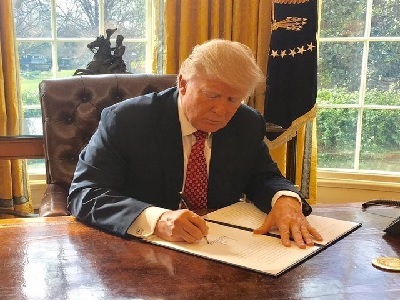
This is now the second Trump presidency and by far the most
disruptive. Recent actions by Trump and his administration
are leading America, and the entire world into chaos.
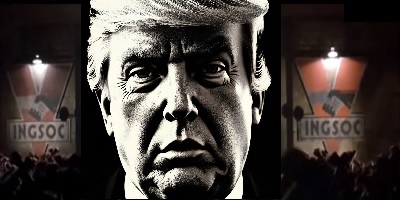
Democracy has eroded into imperialism and America is
sliding into a dystopian society where the privileged few
control and suppress the working class. When Trump was
reelected, it seemed his focus was going to be on domestic
issues but now he has become an imperialist, seemingly bent
on acquiring as much land and the spoils that go with it,
for America, and ultimately to benefit himself.
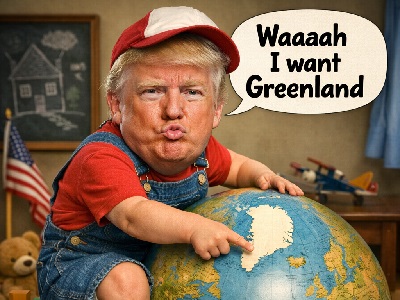
Michael Wolff, author of the book Fire and Fury, reported
that White House staff described the president as
"childlike" due to his need for "immediate gratification,"
inability to read or listen, and general self-focus.
Anyway,
I am not a city person. I have spent many years
living in Japan, and all of it in the countryside. The
people living there are very simple, not in their intellect,
but in the way they live. They are hard working, kind, and
not bothering anybody. This is my image of the people of
Greenland as well. Since this whole Trump/Greenland thing
came up, I began reading a lot about Greenland, the people,
and their culture. Such a proud people, living in a harsh
environment, and from all appearances, very happy. They
exist in harmony and simply want to maintain the status quo.
Although I am living in Japan, I am still American, and this
action to acquire Greenland for America by Trump and his
administration bothers me beyond words.
Below is an explanation why it would be morally wrong for
Donald Trump, or any U.S. president, to invade and claim
Greenland as American territory. The argument is grounded in
political philosophy, ethics, international norms, and moral
responsibility. |
|
|
|
|
 The
Moral Stakes of Territorial Aggression The
Moral Stakes of Territorial Aggression
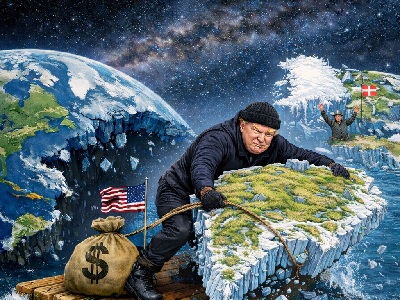
The idea of invading and annexing Greenland is not merely a
strategic or political question; it is fundamentally a moral
one. Territorial conquest in the modern world carries
ethical implications that reach far beyond national interest
or executive authority. Greenland is not an unclaimed
landmass but a populated territory with its own people,
culture, political institutions, and legal status under
international law. Any attempt by a U.S. president—Donald
Trump included—to seize Greenland by force would violate
core moral principles that underpin modern global order:
respect for human autonomy, rejection of imperial
domination, and commitment to peaceful coexistence. To
evaluate the morality of such an act, one must examine
consent, sovereignty, harm, precedent, and moral leadership. |
|
|
Violation of Self-Determination and
Human Autonomy
At the center of the moral objection lies the principle of
self-determination, a cornerstone of modern ethics and
political legitimacy. Greenlanders are not passive objects
of geography; they are a people with the moral right to
decide their own political future. Invading and claiming
their territory would strip them of agency, treating them as
means to an end rather than as moral equals. This violates a
core Kantian ethical principle: human beings must never be
treated merely as instruments for another’s goals, whether
those goals are economic, military, or geopolitical. Even if
an invading power claimed that annexation would bring
prosperity or security, such paternalistic justification
fails morally. Benefits imposed without consent are not
moral goods; they are coercion disguised as benevolence. The
moral wrong lies not only in the outcome, but in the denial
of choice itself. |
|
|
|
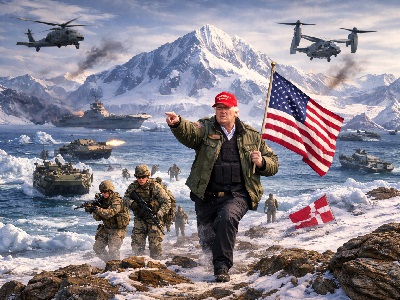 Breach
of Sovereignty and the Moral Fabric of International Order Breach
of Sovereignty and the Moral Fabric of International Order
Sovereignty is not merely a legal technicality; it is a
moral agreement among nations to respect boundaries as a
means of preventing chaos and domination.
Greenland is part of the Kingdom of Denmark, a sovereign
state and longstanding U.S. ally. Invading its territory
would constitute a betrayal of trust and a moral breach of
alliance. Moral obligations are heightened—not reduced—among
allies. To violate the sovereignty of a partner nation
undermines the ethical foundations of cooperation,
reciprocity, and good faith. From a broader moral
perspective, international norms against conquest exist
precisely because history has shown the catastrophic human
cost of imperial expansion. To disregard these norms is to
erode the moral architecture that restrains powerful states
from dominating weaker ones. |
|
|
The Immorality of Imperialism in the
Modern Era
Territorial conquest is morally inseparable from
imperialism, a practice widely recognized as unjust due to
its exploitative and dehumanizing nature. Imperialism
assumes that power confers moral entitlement—that strength
justifies ownership. This logic is ethically bankrupt. It
reduces morality to force and replaces justice with
dominance. Any invasion of Greenland would echo historical
patterns in which powerful nations appropriated land under
the guise of destiny, security, or progress, often at
immense human cost. In the 21st century, such actions are
especially indefensible because alternatives - diplomacy,
treaties, economic cooperation - are readily available.
Choosing invasion over peaceful means signals not necessity,
but moral failure. |
|
|
Foreseeable Harm and Moral
Responsibility for Consequences
Moral evaluation must account for predictable harm, not
merely intent. An invasion would likely cause: |
- Psychological trauma to the civilian
population
- Disruption of local governance and
culture
- Environmental damage in a fragile
Arctic ecosystem
- Military escalation and loss of life
- Global instability and erosion of
trust in international institutions
|
|
Even if the invasion were swift or minimally violent, the
moral responsibility remains. Causing harm when it is
foreseeable and avoidable is ethically culpable. The absence
of extreme violence does not absolve the moral wrong of
coercion and domination. |
|
|
|
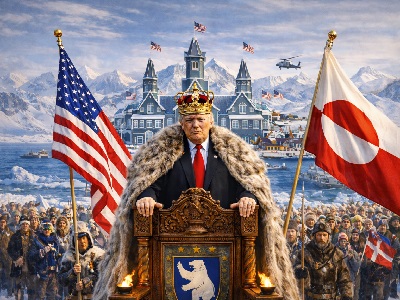 Dangerous Precedent and the Erosion
of Global Ethics Dangerous Precedent and the Erosion
of Global Ethics
One of the gravest moral consequences would be the precedent
such an act sets. If the United States - a nation that
positions itself as a defender of international law - were
to annex Greenland by force, it would implicitly endorse the
idea that power overrides principle. This would weaken moral
arguments against similar actions by other states and
embolden territorial aggression worldwide. Moral leadership
is not defined by strength alone, but by restraint. When a
powerful nation abandons ethical standards, it accelerates a
global race toward might-based morality, where justice is
determined by military capacity rather than ethical
legitimacy. |
|
|
Abuse of Presidential Authority and
Democratic Ethics
From a domestic moral standpoint, such an invasion would
represent an abuse of entrusted power. Presidential
authority is morally justified only insofar as it serves the
public good within constitutional and ethical constraints.
Launching an unprovoked invasion for territorial acquisition
exceeds any morally legitimate mandate granted by the
electorate. It substitutes personal ambition, ideology, or
legacy-building for collective moral responsibility.
Democratic leaders are custodians, not owners, of national
power. Using that power to dominate another people violates
the ethical trust placed in democratic governance. |
|
|
Moral Illegitimacy Beyond Politics
In sum, invading and claiming Greenland as American
territory would be morally wrong regardless of who occupies
the presidency, but it would be no less wrong if undertaken
by Donald Trump. Such an act would violate
self-determination, betray allied sovereignty, revive
imperialist injustice, cause foreseeable harm, destabilize
global norms, and misuse democratic authority. Moral
progress in international relations has been defined by the
rejection of conquest as a legitimate tool of policy. To
reverse that progress is not merely a political
miscalculation—it is a profound ethical regression. True
moral strength lies not in taking what one can, but in
respecting what one has no right to take. |
|
|