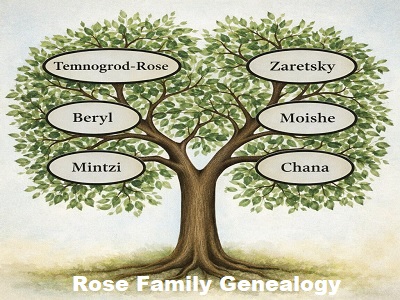
 Rose
Family Genealogy Rose
Family Genealogy
Family and Friends,
This is the genealogy page for the Temnogrod-Rose side of my
family. The Rose family had numerous family reunions and
published fact books containing names, dates, and places.
This was the main source of information for this page, along
with limited information obtained online, primarily from the
"Geni" website. For a detailed list of Rose family members
up to 1995, please refer to the date links in the Genealogy
table below.
For those of you who might be interested in doing your own
genealogy project, please check out
My Genealogical Research Methodology (opens to a new
tab). |
|
|
|
|
|
|
For many years I wanted to trace my family history back as far as I
could, more specifically, the Rose family history. With all of the mundane tasks
and projects that fill our daily lives, it is often difficult to find the time
to work on a project of this magnitude. With us now settled in our new (but
old) home in the Japanese countryside, I decided it was time to finally tackle this
project.
I have files and photos from way back in the day that stayed in storage until
this year, 2026. I spent a couple of months at the beginning of the year, almost
every day, sorting through literally tens of thousands of computer files, and
scanned over 4,000 recent and old photos. Now I am taking the pieces of the
puzzle and putting them together in an organized and meaningful form.
That said, the following genealogical information was obtained from the book given to
attendees of the Rose Family Club 50th Anniversary Gala, which was held on
September 3, 1995 in Toronto, Canada.
Although the information in the book can mostly be found in public records, I
tried to find Sheldon Rose (the compiler of the book) to get permission but to
no avail. I decided to publish this information here anyway since most of it is
itself not copyrighted. Regarding this information, the following should be
noted:
Information for living individuals has been limited for
privacy.
If you are a family member and would like to: |
- discuss the genealogy pages
- look at picture files and help determine the
content (file link will be sent to you)
|
|
Please
contact me
at your convenience. Thanks. |
|
|
|
|
Rose Family Club 50 Year Reunion
Prologue
This is definitely not the great Canadian (or American) novel. What follows over
the next
number of pages is a chronological history of The Rose Family, as detailed by
the submitted
information. This rather ambitious effort began when Anna Mae sent out
questionnaires to
all the Aunts, Uncles and cousins at least 2 years ago ---- the information is
still coming in. I
volunteered to input the information, little knowing what was to come. The
dates, events,
personal reminiscences and anecdotes have formed quite a pile on my desk for the
last 6
months or more. But as I inserted more and more items, it got increasingly
fascinating. This
prompted me to search out additional information. It seemed as though each fact
begged
another question.
Almost every piece of information found its way into the text. I hope that
nothing submitted
was overlooked or incorrectly presented. The historical notes inserted from
"time to time"
may provide some historical perspective to help us understand where we've been
and even
where we're going.
Thanks to all the members of the planning committee for suggestions, ideas and
encouragement. Thanks also to my dear wife Ruth, a most capable production
assistant and
proofreader, to my son Laurence for his computer skills, to my daughter Barbara
and son-in-law Robert for their expertise in helping to format the text and to the whole
family for
providing these facts which surely made this a labour of love.
By the way, aren't you just a little curious, wondering what on earth the title
of this booklet
means? Well, I was told not long ago that our late cousin Sarah was planning to
write a book
about The Rose Family. It was to be appropriately named MGM -- My Guntze
Mishpocha.
Sheldon Rose
Fiftieth anniversary committee:
Anna Mae Belmont
Janice DaCosta
Barry Rose
Dave Rose
Larry Rose
Lil Rose
Sheldon Rose
Lil Saiger
Gail Siegel
“to all of us, let me tell you, we come from good stuff. We make ourselves
belong. We are survivors. We feel. We care. We are warm and loving. Our emotions
run deep. We, as our parents, do not always do the right thing. We make
mistakes. But we are here if you need us. We care.”
Sippy (Rose) Rodin |
|
|
Rose Family Club 40 Year Reunion
Family History ---- 1945
Let's turn back the pages of time, and take a brief glimpse at the Rose family
in the year 1945, when the Rose Family Club was being formed. The idea of
forming a family club had been germinating for years in Zaide Beryl's mind,
after losing his devoted Mintze, especially after some of his daughters and
their families moved to Detroit. He wanted to be sure that " cousins would not
pass each other on the street, and not know they were related."
Everyone had experienced great financial hardships, but the Rose family stuck
together, always helping one another with the few dollars they had at their
disposal. There was always shouting about one family matter or another, but the
next day, it was completely forgotten. The cousins grew up not realizing,
perhaps, how hard their parents worked. Since the Zaide had taught many of his
children the tailoring trade, the family was certainly well-clothed.
Many in the family fondly recall spending Saturday evenings socializing in
Abie's and Mary's grocery store on Dundas Street, after 8 hard week's work. Few
in the family had a car; Toronto Transportation Commission was our means of
travel ( e.g. Sunnyside on weekends, for picnics, swimming, amusements and
bandshell concerts ). However, one unexpected traveller was Louie's and Becky's
dog, Blackie, who would often commute independently to Lil and Eddie's house on
Have lock, using the College streetcar!
1945-46 saw the return of many cousins from the Armed Forces: Murray Rose
returned from Shilo, having met Edith at Harry and Sandy's wedding, while on
leave in 1944.
Eddie Rose returned from Jamaica to a " house-broken " baby, Marlene, then
living with Lil in Vancouver. After his return, the family moved to Toronto,
into Laya and Charlie's former house on Havelock Avenue.
Sidney Ler returned home after being stationed in Camp Borden, and later in
western Canada at a P.O.W. camp.
Yasha ( Sidney's father ) asked Nussie to take Sidney into the factory as an
apprentice, where Simon taught him the cutting trade. Saul Shafer returned home
from British Columbia, and also began working in Simon and Harry's factory on
Beverly St.
Dave Rose returned home after being stationed in England, France, Belguim and
Holland. Nussie had suffered a stroke while Dave was away, and died in November
of 1946, one week after Molly and Dave met. In 1945, the Rose family decided to
formally create a family club; Mary Rose was its first secretary, and Nussie,
being the eldest brother, was its first president. When he died, nobody wanted
to take his place, so the policy of rotating chairmanships began.
In 1943, Nussie and Shaindel and family had moved to Chiltern Hill, at a time
when anyone living near Eglinton Avenue had to be a " giveer " ( wealthy
person). Lil was a lab technician in a doctor's
office, and had kept in close touch with Dave overseas.
In 1945, Louie and Becky and family were living in the apartment above the
College Girls' Coats factory and store. Eddie, Julie and Sarah all worked in the
factory. Tzippy attended Lansdowne School. Many cousins fondly remember getting
a new winter outfit each year at College Girls' Coats.
In 1945, at the end of the war, Laya and Charlie (" Starkman", as he was called
by the Rose family) decided to move to Detroit, where they felt they could make
a better living. Charlie was a presser in a clothing factory. He had earlier
helped to organize a tailors' union in Toronto. Since it was hard to adjust to a
new environment, far from aunts, uncles and cousins in Toronto, Laya, Charlie
and Honey tried to be part of every occasion in Toronto, making frequent trips
here. Morry had been accepted into Medical school at the University of Toronto,
living in Jennie and Boris' home in 1945-46.
By 1945, Bella and Hymie had also moved to Detroit. Hymie had a laundry and
drycleaning store near the Ford plant. Joyce was attending McCoullough Girls'
School, and Ethel was in Central High. Reuben and Chaya and Gert had also moved
to Detroit by 1945. Reuben had a factory near the border crossing that everyone
would visit upon arrival in Detroit, sharing a " Lochaim " with the Crown Royal
whiskey that was always brought from Toronto
In 1945, Abie was working in a garment shop in Toronto. In 1946, looking for
greener pastures, Abie and Mary sold their home on Roxton Rd., and moved with
Sonia and May to Detroit, following Abie's sisters and their families. There,
jobs in the garment industry were plentiful, and the pay was good.
Max and Annie and family lived at 355 Markham St. in 1945. Max had a linen
supply business. He now had a delivery truck, after having used a horse and
buggy for many years. Zaide Beryl would come over at least weekly to sew "
lattes " ( patches ) on the butchers' and store-keepers' aprons that Max
serviced. Edith and Murray were married in 1945, and moved to Hamilton, where
Max and Murray began a new linen supply business. Max would carry sacks of
potatoes and apples on his back, to his relatives. But his nieces and nephews
knew enough to stay away from this cheerful man -- after all, who wanted cheeks
that would hurt for hours after Uncle Max's hard " knipping " (pinching)!
In 1945, Simon was a cutter in Nussie's factory. Simon, Sylvia, Marilyn and
Sheldon lived on Lennox Ave. Times were tough, but the Family Club meetings were
always anticipated with joy. In the early years, meetings were foreyal feasts,"
of corned beef, knishes, etc. Bottles of beer and pop would cool for hours in
ice-filled basement wash-tubs.
Yasha and Minnie Ler and family lived on Stafford St., where their three sons
attended Niagara Street School. Nearby, on Strechan Ave., lived the " Mima " (
aunt ) Rayzel ( Mintze's sister) and her family, including Saul and Ida Shafer.
When Joel was born in December, 1944, he was the proud recipient of the first
baby gift from the Rose Femily Club. When Laya brought this gift for him, she
told Saul and Ida about the Family Club being formed, and asked them to join.
Thus, Bubba Mintze's family became a part of the Rose Family Club.
In 1945, Jennie and Boris and Anna Mae had been living on Carling Ave. for one
year, having moved from a flat on Markham St. All the rooms in the new house
were rented; even the dining room was used as Jennie and Boris' bedroom. Jennie
was working as a finisher in a factory on Spadina Ave., every day taking Anna
Mae to a church nursery on College St. Boris was working in a shoe factory on
St. Patrick St. He spent many contented hours caring for his garden, which was
the pride of the neighbourhood.
Gussie and Dave lived in Jennie and Boris' home in 1945. Gussie worked hard, at
Tip Top Tailors, supporting Dave and managing to save enough money for his
mandolin lessons.
1945 sew Joe working as a driver for Bird's Hill Dairy, and moonlighting as a
waiter at the Metropole Hotel. Joe, Jean, Marilyn and Gail were enjoying their
newly-purchased home on Northoliffe Blvd., after a move from a Crawford St.
flat.
Stanley, Perry and Larry, the youngest of Beryl and Mintze's grandchildren, were
born in the years immediately following the formation of the Rose Family Club.
Chussie and Sima, Beryl and Mintze's oldest daughters, had remained behind in
Pulin, when the family emigrated to Canada. They later perished in the
Holocaust. Had they survived, they and their families would also be members of
the Rose Family Club.
The Rose family continues to grow, not only as Roses by name, but as daughters,
granddaughters and grandsons who have married and taken other names. The Toronto
Roses know their family. Those of us not as fortunate, who live in other
countries, far from family, miss the closeness of relatives. There is now more
of a danger of what Zaide Beryl did not want to happen -- cousins seeing cousins
in passing and not knowing that they are related. How wonderful is our Rose
Family Club that tries to preserve the closeness of the family!
We hope the generations after ours will keep it going. |
|
|
Rose Family Club 35 Year Reunion
Information from Bill Gladstone Genealogy |
- Beryl
Temnegrod and Mintzi Temnegrod had 13 children including:
Max,
Nathan, Chasi, Sima, Louis, Leah, Bella, Chaya, Abie, Gussie,
Jennie, Simeon, and Joe.
- The Roses, who had changed their surname from Temnegrod,
came from the town of Pullen, Ukraine (could not find
information about the existence of the town of Pullen in
2026), near the Polish
border. The 13 surviving children were separated by an age
span of more than 20 years. They were: Nathan, Chasi, Sima,
Louis, Max, Leah, Bella, Chaya, Abie, Gussie, Jennie, Simeon
and Joe. (Bella, Chaya, Bussie, Jennie and Joe were still
living in 1980.) Note: some name spellings are incorrect.
- In Ukraine, Beryl had bribed
officials to keep his sons out of the army. When the
money ran out, Louis and Max managed to escape (most
likely from the pogroms - see below) and came to Canada in 1913. The story goes that,
in Halifax, an immigration officer told Max, “You can’t have
that last name — I’ll give you a good honest name,” then
gave him his own name — Rose.
- Traveling with a cousin, Bella and Leah joined their
brothers in Toronto in 1920; Nathan arrived 1921 with his
young family. Most of the other siblings arrived with their
parents in 1922; the family at first lived on Leonard
Avenue, and eventually on Cecil Street near Grange Avenue.
- Sisters Chasi and Sima, who were already married in Russia,
stayed in the Old Country and died during World War Two.
- Having owned a tailor and yard goods
shop in Russia, Beryl started a needle trade and linen
supply company in Toronto.
- Eleven of Beryl and Mintzi’s 13
surviving children moved from Russia to Canada by the
1920s. Mintzi died in 1933, Beryl in 1945.
- Because Beryl and Mintzi Rose wanted the family to stay
together, Beryl organized a family club in Toronto in 1945,
shortly before he died. In 1980, more than 100 members of
the Rose clan attended a 35th anniversary reunion at Beth
Torah Synagogue, the Canadian Jewish News reported on
October 2, 1980.
During a family dinner, toasts were offered, telegrams read,
speeches made, old home movies shown, awards presented and
old pictures displayed. Participants included Joe, son of
Beryl and Mintzi, and Joe’s son, Larry; Sarah Koszorek, Ida
and Saul Shafer; Dave Rose (grandchildren) and Marilyn and
Marvin Cohen; and Sheldon and Ruth Rose
(great-grandchildren).
It was estimated that four grandchildren were named after
him and another four after Mintzi. Descendants had spread to
Detroit and Los Angeles; those in attendance at the reunion
ranged from 82-year-old Annie (Max’s wife) and two-year-old
Elliott Silverstein.
About 30 relatives attended monthly meetings, said Dave
Rose, who had been the club’s treasurer since its founding.
The club had no president. Sarah Koszorek, who mother was a
daughter of Beryl and Mintzi, said her mother had kept
records of meetings in Yiddish for 27 years. Ida Shafer, a
niece of Beryl and Mintzi’s, had taken over as secretary.
|
|
|
Pogroms
The Russian pogroms from 1900 to 1920 represent a period of
intensified, often state-condoned, anti-Jewish violence in
the Russian Empire, characterized by two major waves: the
1903–1906 riots in the aftermath of the Russo-Japanese War
and the 1917 Revolution, and the massacres during the
Russian Civil War (1918–1920). These violent outbursts
involved widespread looting, arson, rape, and murder,
resulting in tens of thousands of deaths and driving huge
waves of Jewish emigration. |
- First Wave:
1903–1906 (Imperial Crisis)
- Following the economic and social
upheaval at the turn of the century, pogroms erupted as
a violent response to revolutionary movements, with Jews
serving as scapegoats for wider social discontent.
- Kishinev
Pogrom (1903): Sparked by an antisemitic
newspaper blaming Jews for the death of two Christian
children, a three-day riot during Passover left 49 dead,
hundreds wounded, and 700 homes destroyed.
- 1905
Revolution Wave: Following the October Manifesto,
which granted civil liberties, a massive wave of over
600 pogroms occurred in October 1905, with the largest
in Odessa, resulting in over 400 deaths.
- Perpetrators
and Motivation: These pogroms were often carried
out by local populations (urban workers, peasants)
sometimes organized by right-wing groups like the "Black
Hundreds" with police and military complicity. They were
used to distract from anti-government sentiment, with
the Tsar viewing them as loyalists attacking
"revolutionaries".
- Second Wave:
1917–1920 (Russian Civil War)
- The collapse of the Russian Empire
and the subsequent civil war brought unprecedented
levels of violence, particularly in Ukraine, which
accounted for roughly 78% of the pogroms.
- Scope and Death Toll: Approximately
1,500 pogroms occurred in over 1,300 localities, killing
between 35,000 and 250,000 Jews, with 50,000–300,000
children orphaned.
- Perpetrators:
Unlike earlier waves, this violence was often organized
and methodical, carried out by various sides in the
conflict:
- Ukrainian People's Army: Responsible
for 25–54% of the killings.
- White Army (AFSR): 17–50% of the
killings.
- Red Army/Green Armies: Involved in
2–9% of the killings.
- Nature of
Violence: These attacks involved extreme cruelty,
with families burned alive, gang rapes, and massacres in
cities like Proskurov (1919), where 1,500 were murdered
in three days.
- Impact:
The violence was so intense it was described by
historians as a "forgotten genocide" that served as a
precursor to the Holocaust.
- Key
Characteristics (1900–1920)
- Location:
Primarily in the Pale of Settlement, especially Ukraine,
Belarus, and Bessarabia.
- Impact:
Over 2 million Jews emigrated between 1880 and 1920,
with many fleeing to the United States and other
regions.
- Self-Defense:
In response, Jewish communities organized armed
self-defense units, which were active during the 1905
wave and in some areas during the civil war.
-
Legitimization: The violence was often justified
by conspiracy theories that Jews were collectively
responsible for anti-Tsarist revolutionary activities or
for backing Bolsheviks (the "Judeo-Bolshevism" myth).
|
|
|
|
|
Family - Mishpucha (מִשְׁפָּחָה) Listed in Geni |
- Note: The following
information was publicly available on the "Geni" website without requiring a
membership. For a detailed list of Rose family members up to 1995, please
refer to the date links in the Genealogy table at the top of this page. For
detailed information specifically about the Hayman family, please refer to
the date links in the upper right hand column.
- Note: Indented lines denote
the children of the couple listed above.
- Note: Names of living
relatives are listed as "Private" in order to protect their privacy.
Please note that names appearing in, publicly available (no membership
required), written memoriam on the "Geni" website were included on this page
and edited for relevance.
- Great-grandparents (grandfathers
side)
- Beryl Temnegrod - from information below
- Mintzi Temnegrod - from information below
- Children of Beryl and Mintzi
-
Max Rose (my grandfather)
(circa 1898 born in Russia - July 31, 1965 passed
away in Toronto, Canada)
-
Nisin (Nusin) (Nathan) -
(July 2, 1889 (birth records) November 15,
1889 (reunion information) - born in Russia - November 27, 1946 passed
away in Toronto, Canada)
-
Chussie - no online information
-
Sima - no online information
-
Louis - no online information
-
Leah - no online information
-
Bella - no online information
-
Chaia - no online information
-
Abie - no online information
-
Gussie - no online information
-
Jennie - no online information
-
Simon - no online information
-
Joe - no online information
- Great-grandparents (grandmothers side)
-
Moishe Zaretsky -
(circa 1860 born - passed
away)
-
Chana Leah Zaretsky -
(circa 1860 born - passed
away)
- Children of Moishe and Chana
-
Annie (Zaretsky) Rose (my grandmother)
- (circa 1899 born in Russia - March 3, 1991 passed
away in Toronto, Canada) - On Sunday,
March 03, 1991 at Baycrest. Annie Rose, beloved wife of the late Max Rose.
Loving mother and mother-in-law of Lily and Stuart Hayman, of San Diego,
California, and the late Murray Rose and Ethel Silverstein. Devoted grandmother
of Diane Zeidel, Wayne Rose, Alan Silverstein, Cheryl Silverstein, Bonnie Hayman,
and Howard Hayman, and great-grandmother of many. For service information, call
Benjamin's Park Memorial Chapel at 663-9060. Interment Agudas Israel Anashei
Section of Mount Sinai Memorial Park. Memorial donations to Baycrest would be
appreciated.
-
Esther (Zaretsky) Green
- (circa 1896 born - October 25, 1950 passed
away in Toronto, Canada)
-
Isaac Zaretsky
- (circa 1889 born in Minsk, Russia - November
5, 1968 passed away in Toronto, Canada)
-
Aaron Dovid Zaretsky
- (circa 1894 born in Russia - October 14,
1965 passed away in Toronto, Canada)
-
Ida (Zaretsky) Sherman
- (circa 1896 born - April 24, 1990 passed
away in Toronto, Canada)
-
Naftoli Nathan Zaretsky
- (circa 1902 born in Russia - April 20, 1966
passed away in Toronto, Canada)
-
Isadore (Izzy) Zaretsky
- (April 24, 1902 born in Russia - June 6,
1994 passed away in Toronto, Canada)
-
Sadie Zaretsky
- (January 10, 1903 born in Russia - July 18,
1992 passed away in Toronto, Canada)
-
Sarah Zaretsky
- (July 21, 1889 born in Russia - January 31,
1964 - passed away in Toronto, Canada)
-
Reuben Zaretsky
- (September 18, 1892 born - February 4, 1974
passed away in Toronto, Canada)
-
Children of Annie (Zaretsky) Rose (my grandmother) and
Max Rose (my grandfather)
-
Max Rose (my grandfather) - married
Annie (Zaretsky) Rose (my grandmother)
-
Lily (Rose) Hayman (my mom) -
(December 23, 1930 born in Toronto, Canada -
September 28, 1996 passed away in San Diego, California)
- married
Stuart Hayman (my dad) -
(May 21, 1929 born in Buffalo, New York -
April 15, 2004 passed away in San Diego, California)
-
Their children: Private, Private
-
Ethel (Rose) Silverstein (my aunt) -
(June 29, 1925 born in Canada - July 24, 1981 passed
away in Toronto, Canada)
- married
Irving Silverstein (my uncle) -
(circa 1918 born in Ontario, Canada - October
22, 1996 passed
away in Ontario, Canada)
-
Their children: Private, Private
-
Murray Rose (my uncle) -
(December 23, 1923 born in Canada - April 11,
1968 passed
away in Canada)
- married
Edith (Edythe) Rose Blackstien (my aunt) -
(circa 1900s born in Russia - September 16, 2014 passed
away in Toronto, Canada) - On Tuesday,
September 16, 2014 at Sunnybrook Hospital. Beloved wife of the late Murray Rose,
and Samuel Blackstien. Loving mother of Diane and Ron Ennis, and the late Wayne
Rose. Dear sister of Eve Gordon, the late Jack Rosen, Sue Feldman, and the late
Percy Rosen. Devoted grandmother of Marisa and Matthew Siebel, Ilana Zeidel and
David Holland, Sasha Fine and Lauren Fine, great-grandmother of Noah, Austin,
Justin, Evan.
-
Their children:
Wayne Rose -
(December 17, 1951 born - June 5, 2000 passed
away in Key Largo, Monroe County, Florida) -
On June 5, 2000. Beloved husband of Martyne,
devoted father of Sasha and Lauren Fine-Rose, cherished son of Edythe Blackstien
and the late Murray Rose, loving brother to Diane and Ron Ennis., Private
|
Facebook Group Post
The following information was obtained from a group post in
Tracing the Tribe - Jewish Genealogy on Facebook.
A special thanks to Sherrie for posting this information. |
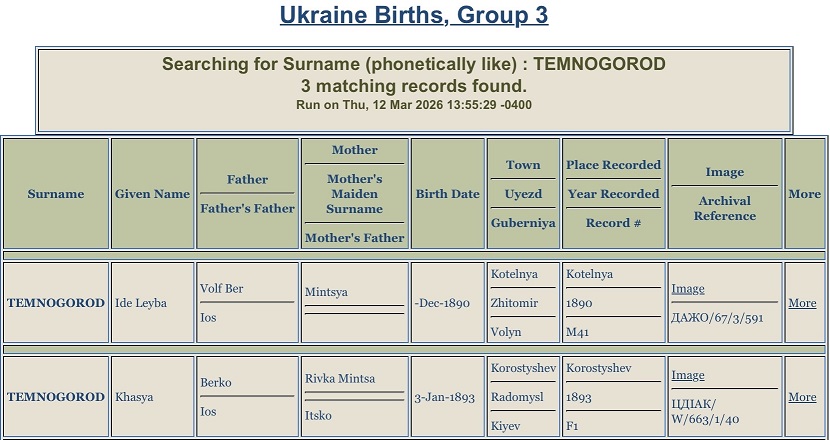
Ukraine Births, Group 3
Click for the unformatted high quality image
Sherri wrote:
I suspect this might be the birth of two of Beril and Mintzi’s daughters.
Beril’s DC says his father is Joseph and Minnie’s burial record says her Hebrew
name is Rivka Mintsya.
Comments: Sherri, please tell me which of the
daughters you think this information might be referencing from the children list
(Children of Beryl and Mintzi) above. The names do not match the names listed.
Maybe the names in the images are more authentic and do not match the romanized
names in the children list. In addition, was wondering if you still have copies of Beril's DC and Minnie's burial
record. The birth dates for Khasya show the same year but different dates in
this record and the following Ukrainian Births record. |
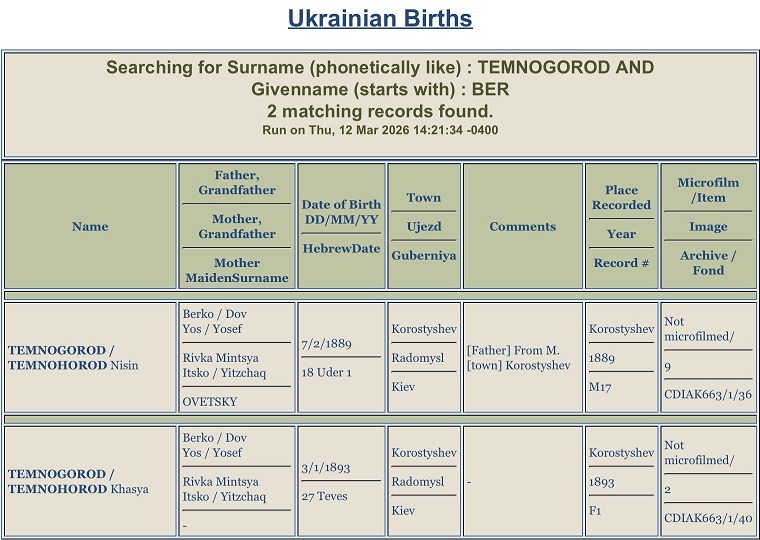
Ukrainian Births
Click for the unformatted high quality image
Sherri wrote:
Here’s the proof positive, birth record for son Nisin includes his mother’s
maiden name, Ovetsky.
Comments: The year Nisin was born matches the
family reunion information. In some records, Nisin (or Nussin) is found as a
diminutive or variant related to names like Nisl or Nusia, often used for Jewish
families in the Russian Empire (specifically the Kiev region/Ukraine). |
- Trivia
- Town - A built-up area
with a name, defined boundaries, and local government, that is larger than a
village and generally smaller than a city.
- Korostyshev - Korostyshiv
is a city in Ukraine. It is situated in the Zhytomyr Raion of the Zhytomyr
Oblast, in the northern part of Ukraine, west of Kyiv. It lies along the
Teteriv River and was historically part of the Russian Empire and
Polish-Lithuanian Commonwealth. Note: Korostyshev is the transliteration
from Russian (Коростышев), or an older anglicized spelling. Korostyshiv is
the transliteration from modern Ukrainian (Коростишів).
- Ujezd - In Russian, the
word уезд (pronounced oo-yezd, transliterated as uyezd or ujezd) refers to a
historic administrative subdivision, roughly equivalent to a "county" or
district. Administrative Division: It was a second-level administrative unit
used in the Grand Duchy of Moscow, the Russian Empire, and the early Russian
SFSR (Soviet Union) from the 13th century until the 1920s. Context: It was a
district surrounding a town that served as its administrative center.
Etymology: The word is derived from the Russian verb уезжать (uyezzhat - to
ride away/leave) or ѣздити (to ride), relating to an area that could be
reached by horseback, or historically, an area surveyed by riding around its
perimeter.
- Radomysl - Radomyshl
(often spelled Radomysl) is not located in Russia, but is a historic city in
Zhytomyr Oblast, northern Ukraine. It lies along the Teteriv River, located
roughly 100km west of Kyiv. It was part of the Kiev Governorate of the
Russian Empire before 1923, but is now firmly in independent Ukraine.
- Guberniya - A guberniya
(governorate or province) was the primary administrative-territorial
subdivision of the Russian Empire, introduced by Peter I in 1708. Headed by
a governor appointed by the tsar, it acted as a local governing unit
overseeing districts (uezd). The term is often translated as "government" or
"province". Initially 8 existed in 1708, growing to over 50 by the late 18th
century. They remained as administrative units in the Soviet Union until
1929.
- Kyiv - Kyiv was
incorporated into the Tsardom of Russia in 1667 following the Truce of
Andrusovo and subsequently became a prominent part of the Russian Empire
from 1721 until 1917. Following the abolition of the Hetmanate in the 18th
century, it was fully integrated as a provincial capital (Kiev Governorate)
within the empire. After the Russian Revolution in 1917, Kyiv became part of
the Soviet Union (USSR) following a period of conflict, until Ukraine gained
independence in 1991.
- Kyiv and Kiev refer to the same city - the capital of
Ukraine - but they represent different language transliterations. Kyiv is
derived from Ukrainian (Київ), while Kiev is derived from Russian (Киев).
Since 2018 - 2019, "Kyiv" has become the standard international spelling to
align with Ukrainian sovereignty and move away from Russian-derived naming
conventions.
|
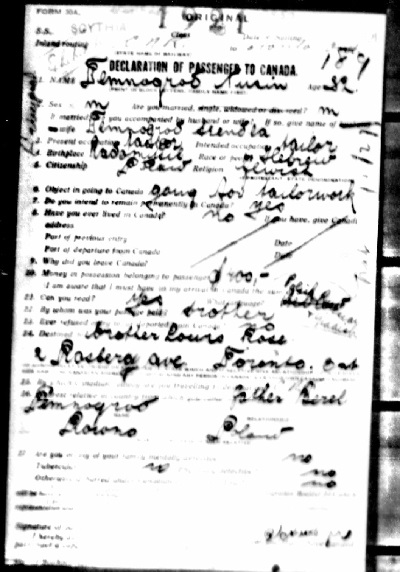
Declaration of Passenger to Canada
Click for the unformatted high quality image
Sherri wrote:
Nusin’s arrival says he was born in Radomsyl, this is the district (similar to a
county) the birth town of Korostyshiv was in (Kiev province).
Comments: This is all getting really confusing. The family
reunion information lists the original family name as "Temnegrod", the
Declaration of Passenger to Canada information lists the name as "Temnogrod",
while the Ukrainian Births information lists "Temnogorod" as the name. This
makes searching reliable genealogical information somewhat difficult. |
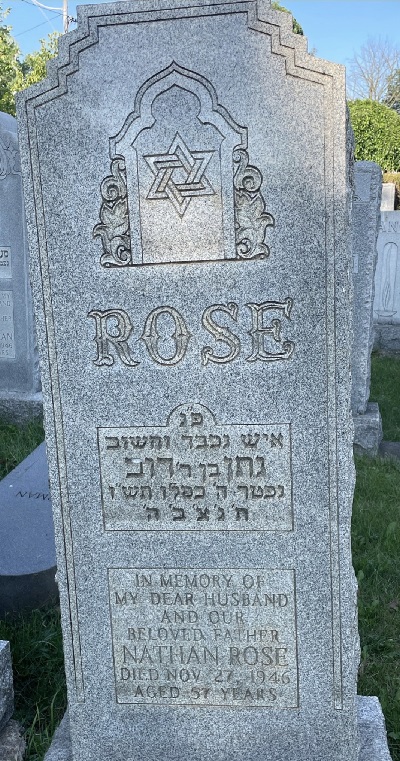
Headstone for Nathan Rose - RIP
Click for the unformatted high quality image
Sherri wrote:
And here’s his headstone in Toronto.
Comments: The information matches exactly with the
reunion information. |
- Information From the Declaration
of Passenger to Canada above
- Date: 1921 - This matches
the year in the reunion information when Nusie and his wife were detained by
immigration in Halifax.
- SS: SOYTHIA - most likely
the name of the Russian steamship Nusin rode on to emigrate to Canada.
- Based on historical immigration and shipping records,
Soythia (often spelled Scythia or Soythia) is a ship name, specifically a
troopship or passenger vessel used during significant migration periods. On
old Russian immigration papers, "ss" likely refers to "Steamship" (often
written as SS or S.S.) preceding the ship's name. "Soythia" is almost
certainly a handwritten or misspelled rendering of the Scythia, a famous
Cunard Line steamship that transported many immigrants. Together, they
identify the vessel and its title.
SS (S.S.): Stands for Steamship, indicating the vessel type. Soythia
(Scythia): The name of the ship, likely the Cunard liner Scythia operating
in the early 20th century. You may find this on passenger manifests or visa
documentation as "SS Scythia." At the beginning of the 1900s, Russian
emigrants traveled to North America primarily via steamships across the
Atlantic Ocean, usually traveling in overcrowded, low-cost steerage sections
below deck. These steamships reduced travel time to about 7–10 days, running
regularly from major European ports like Hamburg, Bremen, and Liverpool. Key
details of the journey:
Land Travel: Emigrants typically traveled by train within the Russian Empire
and across Europe to reach the port cities. Sea Voyage: They boarded large
steamships, such as those operated by the Allan Line or Beaver Line, which
could hold over 1,000 steerage passengers. Conditions: Steerage was known
for being dark, crowded, and uncomfortable, with sleeping quarters often in
large, shared bunks. Routes: While many went directly to US ports like New
York, others took ships to Canada (e.g., Montreal) or first to the UK to
transfer to transatlantic ships.
- Inland routing: CAR -
Inland routing for early-1900s emigrants from Russia (often listed as CAR or
Russian Empire on records) involved a arduous journey from inland villages
to border checkpoints. Most traveled by train—often inefficient, crowded
"colonist cars"—towards major port cities like Libau (Liepāja), Riga, or
Hamburg to cross the Atlantic. Key Aspects of the Inland Routing:
Initial Travel: Many peasants, often fleeing poverty, moved via railways or
horse-drawn transport from rural areas toward western border checkpoints.
Border Controls: The Imperial Russian government heavily restricted
movement, often limiting emigration for ethnic Russians, though many still
managed to leave through designated ports. The Route via Libau: The Russian
American Line provided a key route from Libau (now Liepāja, Latvia) directly
to New York, allowing many to skip the long overland journey through
Germany, according to historical documentation of passenger travel.
Transportation Challenges: Trains often lacked heating in winter and were
extremely slow. Alternative Routes: Many emigrants from the Russian Empire
traveled through Germany (Hamburg or Bremen) or via Baltic ports like Riga.
Note: In this context, "CAR" refers to passenger lists and manifests
documenting emigrants from the Russian Empire ("CAR" or "Car" usually
denoting Carriage/Rail for travel, or in some contexts, part of an error in
transcription for Russian origin).
- Name: Temnogrod, Nusin
- Age: 32
- Sex: m
- Are you married, single, widowed
or divorced?: m
- If married you accompanied by
husband or wife?: No answer
- If so, give name of husband or
wife: Temnogrod, ????
- Present occupation: tailor
- Intended occupation:
tailor
- Birthplace: Radomsyl
- Race or People: Hebrew
- Citizenship: ????
- Religion: Jewish
- Object in going to Canada:
going for tailorwork
- Do you intend to remain
permanently in Canada?: yes
- Have you ever lived in Canada?:
no
- Money or possession belonging to
passenger: ????
- I am aware that I must have on my
arrival in Canada the....????: ????
- Can you read?: yes
- By whom was your passage paid?:
brother
- Ever refused entry to or deported
from Canada?: no
- Destined for: brother
Louis Rose, 2 Rosberg Ave. Toronto, Ont.
- ???? relative or ????:
father Berel Temnogrod
|
|
|
|
|